This guide is written for high school and university physics students studying simple harmonic motion and oscillatory mechanics, undergraduate students conducting laboratory experiments on pendulum gravity determination or spring stiffness, and anyone analyzing systematic experimental uncertainties (finite amplitude, air drag, spring combinations).
“Why doesn’t the mass of the bob affect the period of a simple pendulum ?” “How much does the period lengthen if the swing amplitude exceeds 10° or 20°, and how do you apply Borda’s formula?” “How do series and parallel spring connections change the oscillation period?” “Why is the period of a vertical spring-mass oscillator identical to a horizontal one despite gravitational acceleration?” “What does it mean that velocity leads displacement by 90°?”
The most common stumbling block in oscillatory mechanics is attempting to memorize algebraic period formulas without understanding the linear restoring force requirement () and the physical boundaries of the small-angle approximation.
This guide covers complete derivations of pendulum and spring period formulas, Borda’s finite-amplitude correction lookup table, step-by-step hand calculations for inverting experimental periods into gravitational acceleration , series/parallel spring stiffness rules, 90°/180° kinematic phase shifts, and mechanical energy conservation with free browser tool verification.
First align the experiment and the calculator
| Check | Current tool behavior | Record in your report |
|---|---|---|
| One period | One full return in the same direction | Cycle count N, total time t, T=t/N |
| Length L | Pivot to bob center of mass | Effective length, not just string length |
| Angle | Degrees on screen; radians in series | Initial angle and retained terms |
| Forward period | 1 + θ₀²/16 + 11θ₀⁴/3072 | Truncated approximation, not an exact solution |
| Gravity inversion | Infers T₀ using 1 + θ₀²/16 | Different truncation from forward mode |
| Length target | Uses the small-angle period T₀ | Not a finite-amplitude period target |
In the calculator’s gravity inversion mode, L = 1 m, measured T = 2.008 s and angle 10° give T₀ ≈ 2.0042 s and g ≈ 9.8284 m/s². This is a fabricated instructional dataset, not a measurement of local gravity.
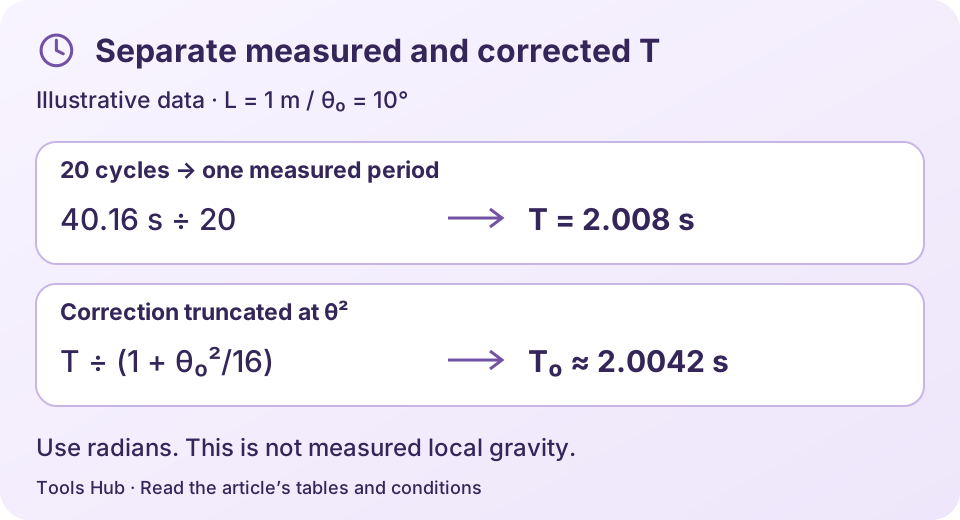
The model assumes a point mass, light inextensible string and negligible friction. Truncation differences increase at large angles. Animations illustrate a model; they do not establish real apparatus losses or safety.
Decision Table: Oscillatory Mechanics Formulas & Key Parameters
The core mechanism governing all simple harmonic motion (SHM) is a restoring force proportional to displacement directed toward equilibrium (). From Newton’s second law , the angular frequency is and the period is .
Simple Pendulum (Small-Angle Approximation):
Period: T₀ = 2π √(L/g) (for θ₀ ≪ 1 rad; independent of bob mass m)
Finite Amplitude (Borda’s Correction): T ≈ T₀ [1 + (1/16)θ₀²] (where θ₀ is in radians)
Gravitational Acceleration Inversion: g = 4π² L / T₀²
Required Length: L = g T₀² / (4π²) (Seconds pendulum T = 2.0 s ⇒ L ≈ 99.4 cm)
Spring-Mass Oscillator:
Period: T = 2π √(m/k) (applies to horizontal, vertical, and inclined systems)
Parallel Springs (Stiffer): k_eff = k₁ + k₂ ⇒ T_parallel = 2π √[m / (k₁ + k₂)]
Series Springs (Compliant): 1/k_eff = 1/k₁ + 1/k₂ ⇒ k_eff = (k₁k₂) / (k₁ + k₂)
Vertical Equilibrium Stretch: x₀ = mg / k (new center of oscillation)
SHM Kinematics & Energy Conservation:
Displacement: x(t) = A cos(ωt + φ)
Velocity: v(t) = −Aω sin(ωt + φ) (leads displacement by 90° / π/2; v_max = Aω)
Acceleration: a(t) = −Aω² cos(ωt + φ) = −ω² x (exact opposite phase 180°; a_max = Aω²)
Mechanical Energy: E = K + U = ½mv² + ½kx² = ½kA² = ½mv_max² (strictly conserved)
| Oscillator System | Period Formula T | Restoring Force F | Frequency f / Angular Freq ω | Physics Features & Constraints |
|---|---|---|---|---|
| Simple Pendulum (Small Angle) | T₀ = 2π √(L/g) | F ≈ −(mg/L)x | ω = √(g/L), f = 1/T₀ | Independent of mass m. High accuracy for θ₀ ≤ 5° (error < 0.05%). |
| Simple Pendulum (Large Angle) | T ≈ T₀(1 + θ₀²/16) | F = −mg sin θ | Effective ω decreases | Period lengthens with swing angle. ~+1.7% delay at θ₀ = 30°. |
| Single Spring-Mass | T = 2π √(m/k) | F = −kx | ω = √(k/m), f = 1/T | Period is unchanged by gravity (horizontal, vertical, inclined). |
| Parallel Springs | T = 2π √[m/(k₁+k₂)] | F = −(k₁+k₂)x | ω = √[(k₁+k₂)/m] | For two identical springs, 2x stiffness halves compliance; period shrinks by 1/√2 ≈ 0.707x. |
| Series Springs | T = 2π √[m(k₁+k₂)/(k₁k₂)] | F = −k_eff x | ω = √[k₁k₂/{m(k₁+k₂)}] | For two identical springs, period increases by √2 ≈ 1.414x. |
1. Simple Pendulum Derivation & Small-Angle Approximation
A simple pendulum consists of an idealized point mass suspended from a frictionless pivot by a massless, inextensible string of length .
     Pivot O
      | \
      |  \  String Length L
      |   \
      |θ   \
Vertical |   ● Bob (Mass m)
      |    ↙ Tangential Restoring Force: F = -mg sin θ
      |   ↓ Gravity: mg
Deriving the Equation of Motion
Let be the angular displacement from the vertical in radians, and be the arc length along the circular path. The two active forces are the string tension and downward gravity .
Resolving forces along the tangential direction:
Since , we have . Dividing both sides by yields the exact nonlinear differential equation:
Small-Angle Linearization ()
The nonlinear term prevents the general motion from being pure sinusoidal harmonic oscillation. However, by expanding into its Taylor series:
when the angle is small (, typically ), higher-order terms become negligible, and we approximate . The differential equation linearizes to:
Setting , the angular frequency is , and the natural small-angle period is:
Why Bob Mass Does Not Affect the Period
The bob mass is absent from the formula .
This occurs because inertial mass (which resists acceleration) is physically identical to gravitational mass (which dictates gravitational force) by the equivalence principle. As a result, mass cancels out completely on both sides of Newton’s second law.
For the same pivot-to-center effective length, mass does not affect the period in the ideal point-mass model with a light, inextensible string and negligible friction. Real bob size and string extension need separate assessment.
2. Finite Amplitude Errors & Borda’s Correction Formula
Introductory physics textbooks state that pendulum periods are constant regardless of amplitude (isochronism). However, in precision physics and experimental measurement, isochronism is only an approximation.
Borda’s Finite Amplitude Expansion
When the release angle increases, the true restoring force falls below the linear line (). Because the restoring force is weaker than linear, the bob accelerates more sluggishly, and the oscillation period lengthens.
While the exact closed-form period requires the complete elliptic integral of the first kind , French astronomer Jean-Charles de Borda derived the standard truncated series expansion:
where must be supplied in radians ().
Amplitude Error Lookup Table
The following table calculates the percentage lengthening over the small-angle period for typical release angles:
| Swing Angle θ₀ (deg) | Angle (rad) | Borda Factor (1 + θ₀²/16) | Period Increase (%) | Compare with required precision |
|---|---|---|---|---|
| 2.0° | 0.0349 rad | 1.000076 | +0.008% | Compare with the required uncertainty. |
| 5.0° | 0.0873 rad | 1.000476 | +0.048% | Check whether a roughly 0.05% difference is acceptable. |
| 10.0° | 0.1745 rad | 1.001904 | +0.19% | Measurable discrepancy in 3–4 significant figure timing. |
| 15.0° | 0.2618 rad | 1.004284 | +0.43% | Consider correction if targeting uncertainty below 0.43%. |
| 20.0° | 0.3491 rad | 1.007615 | +0.76% | Causes a ~1.5% systematic underestimation in inverted g. |
| 30.0° | 0.5236 rad | 1.017135 | +1.71% | About 1.7% period difference; consider higher-order terms. |
This table truncates the correction at 1 + θ₀²/16. Including the fourth-order term at 30° gives approximately 1.017404. Compare with the required precision; these are not universal pass/fail thresholds.
Lab Report Note:
Because gravitational acceleration scales inversely with period squared (), a +1% error in period results in an approximate -2% underestimation in the calculated value of .
If experimental swings reach 15° to 20°, applying Borda’s correction explains systematic discrepancies in your lab report discussion.
3. Laboratory Gravity Determination () & Error Analysis
Determining local gravitational acceleration using a simple pendulum is a staple experiment in undergraduate physics.
[Experimental Setup]
Rigid Pivot ──── String Length L ──── Spherical Bob (Effective L_eff = L + r_bob)
Why Lab Experiments Measure 20 to 50 Cycles
With manual timing, measuring several cycles (for example 20 or 50) and dividing by N can reduce the relative effect of start/stop timing offsets. Choose N for the apparatus, damping and laboratory instructions. Photogates or video may measure a single period; there is no universal minimum of 20 cycles.
If we assume a total-time uncertainty of 0.15 s, it is 7.5% of a 2 s cycle but 0.375% of 40 s across 20 cycles. This is an illustrative assumption, not a measured human reaction-time result. More cycles do not automatically reduce length error, damping or miscounts. Use the same position and direction for each cycle and repeat the measurement.
Worked Lab Calculation: Inverting for
- Illustrative measurement data:
- Effective pendulum length to bob center of mass:
- Measured swing angle: ()
- Recorded time for 20 oscillations:
- Measured experimental period:
Step 1: Recovering Small-Angle Period via Borda
Step 2: Calculating Local Gravitational Acceleration
(Without Borda’s correction, using yields , about 0.037 m/s² below the corrected estimate. Standard gravity is a conventional reference, not a measured value at this location; closeness to it does not determine which experimental result is correct).
4. Spring-Mass Oscillators: Series/Parallel Combinations & Vertical Shift
A spring-mass oscillator uses an elastic spring obeying Hooke’s law () attached to an inertial mass .
Natural Period Formula
With spring constant (N/m) and mass (kg), Newton’s second law gives angular frequency and period:
For an ideal linear spring with negligible spring mass and friction, the period depends on mass and stiffness, independently of amplitude and a constant gravitational acceleration.
Why Vertical Spring Oscillators Have the Same Period as Horizontal Ones
When an oscillator hangs vertically, gravity pulls downward continuously. Why does the horizontal period formula remain unchanged?
[Vertical Spring Dynamics]
Ceiling ─── Natural Length ─── [Static Stretch x₀ = mg/k] ─── Arbitrary Displacement y ─── ●
Total Restoring Force: F = mg - k(x₀ + y) = mg - kx₀ - ky = -ky- Proof:
- Hanging mass from a vertical spring stretches it to a static equilibrium position where gravity balances spring tension: .
- Defining this equilibrium position as the origin () with downward displacement , the net force on the mass is:
- Substituting the equilibrium condition cancels the gravitational constant term:
- The equation of motion becomes , identical to horizontal oscillation.
Conclusion: Gravity merely shifts the center of oscillation downward by . It does not alter the stiffness slope (), so the period remains completely invariant.
Parallel and Series Spring Combinations
[Parallel: 2x Stiffer]          [Series: Softer / Compliant]
     Ceiling                          Ceiling
    ┌───┴───┐                            │ Spring k₁
   ⌇ k₁    ⌇ k₂                         │ (Stretch x₁)
    └───┬───┘                            ├──
        ● Mass                           │ Spring k₂
                                         │ (Stretch x₂)
                                         ● Mass
1. Parallel Springs
Both springs undergo identical displacement . Total restoring force is the sum of both forces: Two identical springs () double stiffness (), shortening the period to .
2. Series Springs
Under load , each spring experiences identical tension, and total stretch is additive (): Two identical springs halve stiffness (), lengthening the period to .
Cutting a Spring in Half:
Cutting a spring of stiffness in half doubles its spring constant to (twice as stiff).
The original spring acts as two half-springs in series: . Under a given load, halving active coils halves elongation, doubling stiffness.
5. SHM Kinematics, 90°/180° Phase Shifts & Energy Conservation
Kinematic Equations
Given amplitude and initial phase :
- Displacement :
- Velocity (First Derivative): Peak velocity is . Because phase advances by (+90°), velocity leads displacement by 90°.
- Acceleration (Second Derivative): Peak acceleration is . Inverting sign () advances phase by (+180°), so acceleration is in exact opposite phase (180°) with displacement.
Physical Intuition for Phase Shifts
- At Maximum Displacement (): The bob instantaneously halts at the turnaround point (), but spring tension is maximized, producing peak acceleration ().
- At Equilibrium Center (): Spring extension and acceleration are zero (), but velocity reaches its absolute maximum ().
Conservation of Mechanical Energy Proof
Calculating kinetic energy and potential energy :
Summing both expressions yields total mechanical energy :
Kinetic and potential energy continuously interchange at twice the oscillation frequency (), while total energy remains constant throughout motion.
6. Worked Numerical Examples (5 Practical Scenarios)
Example 1: Seconds Pendulum Length
Problem: Calculate the length required for a simple pendulum to oscillate with period in standard gravity .
- Calculation:
- Result: 99.4 cm (the historical standard for clockmaker regulator pendulums).
Example 2: An Ideal Long Pendulum
Problem: An illustrative ideal pendulum has effective length and bob mass . Taking the assumed gravity as , find its period. How does period change if mass is doubled to 56 kg?
- Calculation:
- Result: Period is 16.4 seconds. Doubling mass leaves period completely unchanged.
Example 3: Lab Spring Oscillator Kinematics
Problem: A spring of stiffness carries mass and oscillates horizontally with amplitude (). Find period , maximum velocity , and maximum acceleration .
- Calculation:
- Result: Period 0.628 s, max speed 0.500 m/s, max acceleration 5.00 m/s².
Example 4: Parallel vs Series Springs
Problem: Two springs have constants and . For load , calculate effective stiffness and period for (a) parallel and (b) series configurations.
- Calculation:
- (a) Parallel:
- (b) Series:
- Result: Parallel: , . Series: , .
Example 5: Vertical Spring Stretch & Total Energy
Problem: A vertical spring () supports mass in gravity . Determine static equilibrium stretch . If pulled downward () and released, find total mechanical energy .
- Calculation:
- Result: Stretch 7.84 cm, mechanical energy 0.090 J (90.0 mJ).
7. Verifying Lab Results with the Tools Hub Calculator
You can verify derivations and visualize phase waveforms in your browser using the Simple Harmonic Motion & Pendulum Calculator.
[Simple Harmonic Motion Calculator Features]
┌────────────────────────────────────────────────────────┐
│ [Pendulum Tab]   [Spring Tab]   [Waveform & Energy Tab]│
├──────────────────────────┬─────────────────────────────┤
│ ・Target: T / g / Length │ ・Live Vector SVG Simulation│
│ ・Length L, Angle θ₀     │ ・Period, Borda Corrected T │
│ ・Gravity presets (Earth)│ ・Step-by-step arithmetic   │
├──────────────────────────┴─────────────────────────────┤
│ [ Copy Lab Report Summary ]   [ Reset to Defaults ]    │
└────────────────────────────────────────────────────────┘- Pendulum Inversion: Select the Simple Pendulum tab, set target to Invert Gravity from Measured Period, and enter string length and period . The tool instantly calculates Borda-corrected small-angle period and local gravity .
- Spring Oscillator Combinations: In the Spring Oscillator tab, switch between Single, Parallel, and Series configurations to verify effective stiffness , frequency, and equilibrium elongation .
- One-Click Report Copy: Click Copy Lab Report Summary to export formatted Markdown parameters and equations directly into your lab report.
8. Frequently Asked Questions (FAQ)
Q1. What happens if the pendulum string has non-negligible mass?
For a small-angle model treating the string as a uniform rigid rod, when string mass cannot be ignored, the system must be analyzed as a physical pendulum. The moment of inertia becomes , and period is calculated from . This shifts the center of mass closer to the pivot while increasing inertia, slightly altering the period.
Q2. How does an elevator’s acceleration affect pendulum period?
When an elevator accelerates upward at rate , downward inertial force increases effective gravity to , shortening the period (). Accelerating downward decreases effective gravity, lengthening the period. In free fall (), effective gravity drops to zero, and the pendulum ceases to oscillate.
Q3. Does a spring-mass oscillator work in a zero-gravity space station?
Yes, with identical frequency and period.
Spring restoring forces depend exclusively on elastic stiffness (). In weightless environments, a spring oscillator behaves exactly as on Earth: . In fact, specialized body-mass measurement devices on the International Space Station determine astronaut weight by timing spring-oscillation periods.
Q4. What does it mean graphically that velocity leads displacement by 90°?
On a time-domain plot, velocity peaks precede displacement peaks by one-quarter of an oscillation cycle (, or 90° / radians). When displacement reaches its positive peak (), velocity is zero; velocity reached its positive maximum earlier as the mass crossed the equilibrium origin.
Q5. How does air resistance (damping) affect the period?
For velocity-proportional drag (), the underdamped case has oscillations with damped angular frequency . Consequently, damping lengthens the oscillation period (slightly when damping is weak) (). At critical or stronger damping there is no repeated oscillation, so this period formula does not apply.
9. References & Related Tools
Authoritative Academic Sources
- OpenStax University Physics Vol 1 (Rice University)
Chapter 15: Oscillations — https://openstax.org/books/university-physics-volume-1/pages/15-1-simple-harmonic-motion
Foundational derivations of harmonic motion, spring dynamics, and small-angle pendulums. - The Feynman Lectures on Physics Vol. I (Caltech)
Chapter 21: The Harmonic Oscillator — https://www.feynmanlectures.caltech.edu/I_21.html
Restoring forces, angular frequencies, and complex phase geometry. - OpenStax University Physics Vol 1
Chapter 15.4: Pendulums — https://openstax.org/books/university-physics-volume-1/pages/15-4-pendulums
Simple pendulum dynamics and finite amplitude behavior.
Related Tools Hub Calculators
- Simple Harmonic Motion & Pendulum Calculator: Real-time simulation of pendulums, spring systems, and energy conservation.
- Error Propagation Calculator: Propagate measurement uncertainties (, ) into gravity estimates ().
- Constant Acceleration Calculator: Solve linear kinematics under gravitational acceleration.
- Projectile Motion Calculator: Trajectory calculations for 2D gravitational motion.
Measurement uncertainty and the return workflow
For independent standard uncertainties in L and T₀, neglecting uncertainty in the angle correction, first-order propagation gives . Consider length offsets, timing scatter, amplitude decay and series truncation separately. Correlations or appreciable angle uncertainty require a fuller treatment.
- Copy the calculator output, then add your observations, assumptions, units and retained correction terms. Copied text alone is not experimental evidence.
- Favorite the tool near its name to reopen it through My Tools in the same browser. This does not save the inputs.
- At the next measurement, check that settings match before comparing with your recorded results.
On October 24, 2026 we compared the worked example and the tool’s modes and truncation orders. References support the theory; they do not certify this site’s calibration or experimental apparatus.