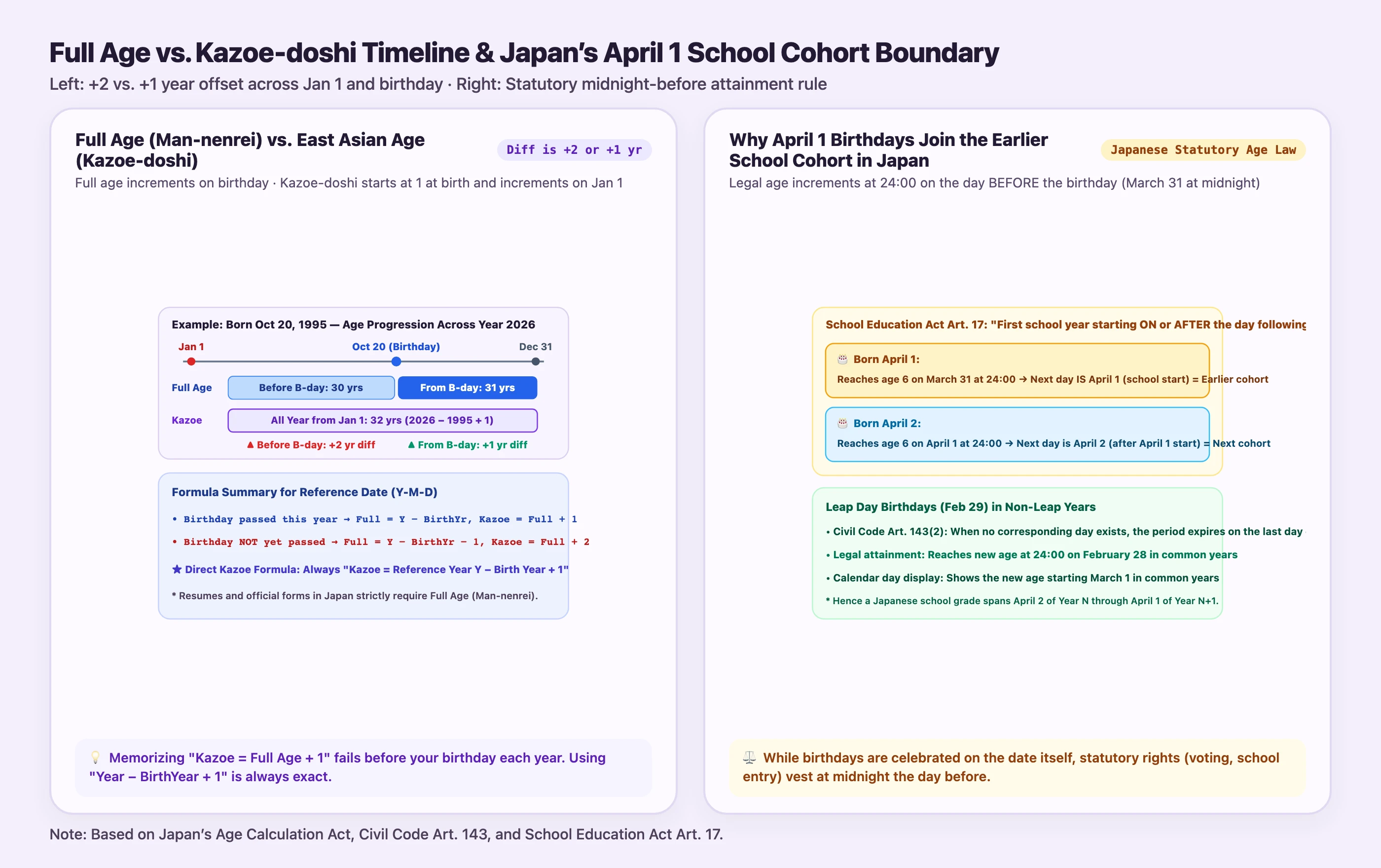
Chronological age is reference year minus birth year, subtracting one if the birthday has not yet occurred. Japanese traditional counted age, kazoe-doshi, is reference year minus birth year plus one. It is not always exactly one greater than chronological age.
Example: born October 20, 1995
At May 1, 2026, the year difference is 31, but the birthday is still ahead: chronological age 30, counted age 32.
| Reference date | Chronological age | Counted age |
|---|---|---|
| May 1, 2026 | 30 | 32 |
| October 20, 2026 | 31 | 32 |
| January 1, 2027 | 31 | 33 |
Japan’s April 1 school-year boundary
MEXT explains that Japanese statutory age is attained at the end of the day before a birthday. An April 1 birthday reaches six at the end of March 31. The school-year birth cohort therefore runs from April 2 through the following April 1.
This is a Japanese statutory and school-enrolment explanation. Do not generalize it to other jurisdictions. A legal attainment date and a date-based calculator display are different conventions; check the authority’s instructions for eligibility or deadlines.
Comparison Table: Chronological Age, Counted Age & Japanese Statutory Rules
| Method / Rule | Starting Age at Birth | When Age Increments | Formula & Practical Notes |
|---|---|---|---|
| Chronological Age (Calendar Display) | 0 years old at birth | On the birthday date each year | Ref Year − Birth Year − (1 if before birthday); standard for resumes and everyday forms |
| Japanese Statutory Attainment | Includes birth date (Day 1) | At 24:00 on the day before the birthday | Japan's Age Calculation Act & Civil Code Art. 143(2); governs voting age and school-year cutoff |
| Counted Age (Kazoe-doshi) | 1 year old at birth | Every January 1 (New Year's Day) | Ref Year − Birth Year + 1; equals chronological age + 2 before the birthday, and + 1 from the birthday onward |
| April 1 Birthdays (Japan School Cohort) | Counted from April 1 birth date | Attains age 6 at 24:00 on March 31 | Enters the earlier school cohort (April 2 – following April 1) because age 6 is legally reached by April 1 |
| February 29 Birthdays (Common Year) | Counted from Feb 29 birth date | Statutory: 24:00 on Feb 28; Display: March 1 | Civil Code Art. 143(2) proviso uses the final day of the month (Feb 28); date-based web tools switch on March 1 |
February 29 birthdays in a non-leap year
February 29 is absent. Japan’s calendar-period rules involve the end of February. This tool’s day-based display changes the age on March 1 in a non-leap year. Distinguish that display from a legally described attainment day.
Reproduce the example
The Age Calculator displays today’s chronological age and days to the next birthday. It has no reference-date field or counted-age output. The May 1 example above is a hand calculation, not a calculator input sequence.
Use the formula with the reference date required by the destination. To convert between Japanese imperial eras (Showa, Heisei, Reiwa) and Western years, use the Japanese Era Converter. See the Date Calculator and date differences for elapsed-day conventions.
Frequently asked questions
Must Japanese celebrations use counted age?
Practices and organizer instructions vary. Check the relevant shrine or event; there is no sourced usage percentage in this article.
Can the tool calculate age on a future date?
It uses today. Use the article formula for a future reference date. Future birth dates are rejected.
What was checked
On October 10, 2026, MEXT’s explanation and the tool’s date conventions were checked. The old link, unsupported celebration-usage statistic and jurisdiction-wide claims in the English article were corrected.