This guide is for high school and first-year university students solving half-life problems, and for anyone reading remaining amounts or carbon-14 dating figures.
“How much is left after three half-lives?” “Why does a logarithm appear when I solve for elapsed time?” “Should I use e or 2 in the decay formula?”
The half-life formula fits on one line. Most errors come from skipping the step of counting how many half-lives have passed (t/T), and from mixing up exponents, units and logarithms. This guide covers the three ways to solve for the remaining amount, the elapsed time and the half-life, with worked examples, common mistakes and checks.
Key formula and the three solving paths
N = N₀ × (1/2)^(t/T)
- N₀: initial amount (mass, number of nuclei or activity; any unit)
- N: amount remaining at time t (same unit as N₀)
- T: half-life (same time unit as t)
- t: elapsed time
Calculate t/T, the number of elapsed half-lives, first. If t/T = 2, the remaining fraction is (1/2)² = 1/4.
| Quantity to find | Formula |
|---|---|
| Remaining amount N | N = N₀ × (1/2)^(t/T) |
| Elapsed time t | t = T × log₂(N₀/N) |
| Half-life T | T = t × ln 2 ÷ ln(N₀/N) |
For example (N₀ = 100, T = 10 days), 12.5 remains after 30 days. An amount of 20 remains after about 23.2 days, and a sample that falls to 25 after 20 days has a half-life of 10 days.
Rule of thumb: if the remaining fraction is 1/2ⁿ, then n half-lives have passed. A remaining fraction of 1/8 means 3 half-lives.
1. What a half-life means
A half-life is the time required for half of a quantity to decay. The JAEA glossary (ATOMICA, in Japanese) explains that when a quantity falls exponentially, its half-life does not depend on the starting amount. Each radioactive nucleus has the same probability of decaying within a given time, so the amount of radioactive material falls exponentially (JAEA ATOMICA).
Textbooks describe the decay with a decay constant λ (OpenStax Chemistry 2e):
λ = ln 2 ÷ T ≈ 0.693 ÷ T
N = N₀ × e^(−λt)
Substituting λ gives e^(−λt) = e^(−(ln 2)·t/T) = 2^(−t/T) = (1/2)^(t/T). The e form and the 2 form describe the same decay.
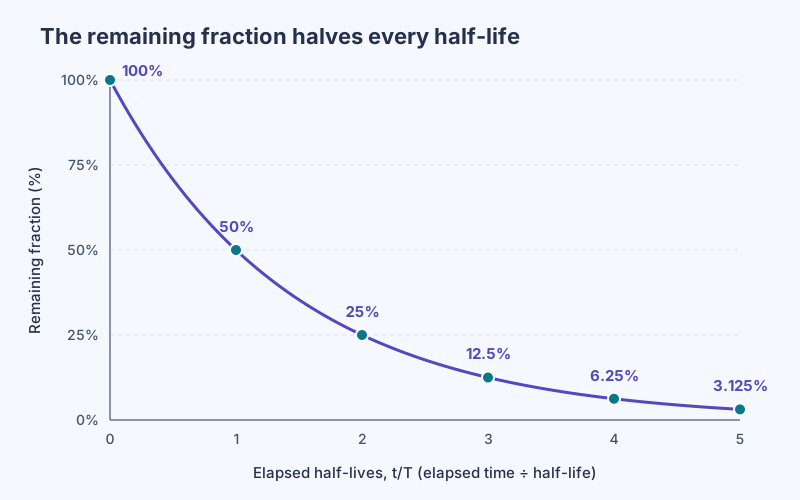
| t/T | Remaining fraction | Amount (N₀ = 100) |
|---|---|---|
| 0 | 1 (100%) | 100 |
| 1 | 1/2 (50%) | 50 |
| 2 | 1/4 (25%) | 25 |
| 3 | 1/8 (12.5%) | 12.5 |
| 4 | 1/16 (6.25%) | 6.25 |
| 5 | 1/32 (3.125%) | 3.125 |
2. Remaining amount: N = N₀ × (1/2)^(t/T)
Use three steps: divide the elapsed time by T, raise 1/2 to that power, then multiply by N₀.
Example 1 (whole half-lives): initial amount 100 g, half-life 10 days, elapsed time 30 days.
- t/T = 30 ÷ 10 = 3
- N = 100 × (1/2)³ = 100 × 0.125 = 12.5 g
Example 2 (part of a half-life): the same sample after 25 days.
- t/T = 25 ÷ 10 = 2.5
- N = 100 × (1/2)^2.5 = 100 × 1/4 × 1/√2 ≈ 17.68 g
Think of 2.5 half-lives as two halvings, which leave 1/4, followed by half a half-life, which multiplies the amount by 1/√2 ≈ 0.707.
Example 3 (carbon-14): the half-life is 5,730 years (NOAA GML).
- After 11,460 years (t/T = 2): 25% remains
- After 17,190 years (t/T = 3): 12.5% remains
Example 4 (cobalt-60): the half-life is 5.27 years. After 15 years, t/T = 15 ÷ 5.27 ≈ 2.846, so (1/2)^2.846 ≈ 0.139, or 13.9%. The OpenStax textbook rounds λ to 0.132 per year before calculating, which gives 13.8%. The rounding changes the last digit.
3. Elapsed time: use log₂
Taking log₂ of both sides of N/N₀ = (1/2)^(t/T) gives:
t = T × log₂(N₀/N)
If your calculator has no log₂ key, use:
log₂x = log₁₀x ÷ log₁₀2 = ln x ÷ ln 2 (log₁₀2 ≈ 0.30103; ln 2 ≈ 0.69315)
Example 5: initial amount 100, remaining 20, half-life 10 days.
- log₂(100 ÷ 20) = log₂5 ≈ 2.3219
- t = 10 × 2.3219 ≈ 23.2 days
- Check: 100 × (1/2)^2.32 ≈ 20.03
For the basics, see the logarithm guide and the exponent guide.
4. Half-life from measurements
T = t × ln 2 ÷ ln(N₀/N)
Example 6: a sample of 100 falls to 30 after 20 days.
- ln(100 ÷ 30) = ln 3.333 ≈ 1.2040
- T = 20 × 0.6931 ÷ 1.2040 ≈ 11.5 days
In a real experiment, use several measurements rather than two. Plot ln N against time: the points lie on a straight line whose slope is −λ = −ln 2 ÷ T, so T = −ln 2 ÷ slope. This reduces the effect of a single noisy reading.
5. Check the result with the calculator
Check Example 3 (carbon-14)
Press "C-14, 2 half-lives". The inputs are an initial amount of 100, a half-life of 5730 and an elapsed time of 11460. The remaining amount is 25, and the remaining percentage is 25%.
Check a fractional half-life
Press "half a half-life". The inputs are 100, 10 and 5, and the remaining amount is 70.710678. Enter the 25-day elapsed time from Example 2 to get about 17.68.
Re-enter a back-calculated value
Enter the 23.2 days from Section 3 as the elapsed time, with a half-life of 10. The remaining amount is about 20. The working also shows t/T and the decay constant λ = ln 2 ÷ T.
Careful: the calculator computes the remaining amount. It does not solve for elapsed time or half-life, so use the formulas in Sections 3 and 4, then enter the values to check.
6. Common mistakes and fixes
Mistake 1: Using e^(−t/T)
At t = T, e^(−1) ≈ 0.368, not 0.5. If you use e, the exponent must be −λt with λ = ln 2 ÷ T.
Mistake 2: Confusing half-life with mean life
The mean life τ equals 1/λ, which is T ÷ ln 2 ≈ 1.443 T. For T = 10 days, τ ≈ 14.4 days. The half-life is the time for half of the amount to remain. The mean life is the time for the amount to fall to 1/e, about 36.8%.
Mistake 3: Mixing units
If the half-life is in years but the elapsed time is entered in days, the ratio is wrong. For example, T = 5,730 years with an elapsed time of 11,460 days (about 31.4 years) gives a remaining fraction of about 99.6%, which hides almost all of the decay. Convert T and t to the same unit first.
Mistake 4: Rounding the number of half-lives down
The number of half-lives needed to reach 1% is log₂100 ≈ 6.64. After 6 half-lives, 1.56% remains; after 7, 0.78%. “Six half-lives gives 1%” is wrong.
Mistake 5: Rounding intermediate values too early
In the cobalt-60 example, rounding λ to 0.132 changes the answer from 13.9% to 13.8%. Keep full precision through the calculation and round only at the end, following the significant figures guide.
7. Limits and conditions
- The formula applies when one radionuclide decays by a first-order process.
- If the decay products are also radioactive and you need their amounts, you need the equations for a decay series. The calculator does not handle this case.
- With very few nuclei, individual decays are random. The formula describes the average behavior of many nuclei.
- The rate of radioactive decay does not depend on temperature or on the chemical form of the substance (UC Davis Chem 2C, LibreTexts). Loss from a container or a chemical reaction is a different process.
- For carbon-14, the true half-life is 5,730 years, while the conventional value used for reporting radiocarbon ages is Libby’s 5,568 years. Check which value a source uses before you calculate an age, because calibration is also required (University of Oxford).
- OpenStax notes that radioactive dating works for about 10 half-lives, which gives a carbon-14 limit of about 57,000 years (OpenStax).
Frequently asked questions
Does radioactive material disappear after one half-life?
No. After one half-life, half of the amount remains. In principle, the amount never reaches zero, however many half-lives pass. In practice, people use a threshold such as “below the detection limit.”
Does temperature or pressure change the half-life?
For radioactive decay, the half-life is treated as independent of temperature and of the chemical or physical form of the substance (UC Davis Chem 2C, LibreTexts). Other processes that reduce an amount, such as leakage or chemical reaction, are separate.
How do I calculate log₂ without a log₂ key?
Use log₂x = log₁₀x ÷ log₁₀2, or ln x ÷ ln 2. The logarithm calculator offers base 2 as a one-tap option.
Do the e form and the 2 form give the same answer?
Yes. Combining N = N₀ × e^(−λt) with λ = ln 2 ÷ T gives N = N₀ × (1/2)^(t/T). When you count elapsed time in half-lives, the (1/2)^(t/T) form is easier to read.
Summary
- Remaining amount: N = N₀ × (1/2)^(t/T)
- Elapsed time: t = T × log₂(N₀/N)
- Half-life: T = t × ln 2 ÷ ln(N₀/N)
- Count the elapsed half-lives first, as t/T
- Use the same unit for T and t, and round only at the end
The tool featured in this article
Half-Life Calculator
Compute the remaining amount and remaining percentage with N = N₀ × (1/2)^(t/T), with a carbon-14 example and the working for t/T and λ. Runs in your browser, free, no sign-up.