Know the solute’s mass but need mol/L? Unsure how much water a dilution requires? Start by separating amount of substance, concentration and total solution volume. These are teaching calculations. For measured results, also check the reagent’s composition and purity, and the conditions of volume measurement.
Choose the formula from the quantity you need
| Known quantities | Quantity to find | Formula and units |
|---|---|---|
| Mass m, molar mass M | Amount n | n (mol) = m (g) / M (g/mol) |
| Amount n, solution volume V | Molarity C | C (mol/L) = n (mol) / V (L) |
| Molarity C, solution volume V | Solute mass m | m (g) = C (mol/L) × V (L) × M (g/mol) |
| Stock C₁, target C₂, final volume V₂ | Required stock volume V₁ | V₁ = C₂V₂ / C₁ |
See the definition in OpenStax’s Molarity chapter. V is the volume of the whole solution after dissolving the solute, not the water alone.
Worked example: mass to molarity
Suppose 5.844 g of NaCl makes a total solution volume of 500.0 mL, using a molar mass of 58.44 g/mol for this example.
- Amount: n = 5.844 g ÷ 58.44 g/mol = 0.1000 mol.
- Volume: V = 500.0 mL ÷ 1000 = 0.5000 L.
- Molarity: C = 0.1000 mol ÷ 0.5000 L = 0.2000 mol/L.
The units follow (g ÷ g/mol) ÷ L = mol/L. Substituting 500.0 without converting to liters gives 0.0002000, a thousand times too small if labeled mol/L.
Reverse calculation: required mass
For 250.0 mL at 0.2000 mol/L, using the same molar mass, m = 0.2000 × 0.2500 × 58.44 = 2.922 g. Cross-check that concentration times volume returns 0.05000 mol.
Use the molar mass for the actual reagent formula. Hydrates include their water of crystallization; a reagent below 100% purity also needs a purity correction. This example and the calculator’s basic mass calculation assume the entered mass is the mass of the target solute.
Dilution: what C₁V₁=C₂V₂ means
The equation follows from conserving the amount of the target solute. It does not directly cover reactions or solute loss.
- C₁: stock concentration
- V₁: stock volume taken out, not the volume of the entire stock bottle
- C₂: target concentration after dilution
- V₂: total final solution volume
Example: 100 mL at 0.10 mol/L from a 1.0 mol/L stock
V₁ = (0.10 mol/L × 100 mL) ÷ 1.0 mol/L = 10 mL.
With matching concentration units and the same units for V₁ and V₂, this ratio calculation can keep mL. To check the amount in mol, convert the volumes to L.
| State | Concentration C | Solution volume V | Amount n = CV |
|---|---|---|---|
| Stock aliquot | 1.0 mol/L | 10 mL = 0.010 L | 0.010 mol |
| After dilution | 0.10 mol/L | 100 mL = 0.100 L | 0.010 mol |
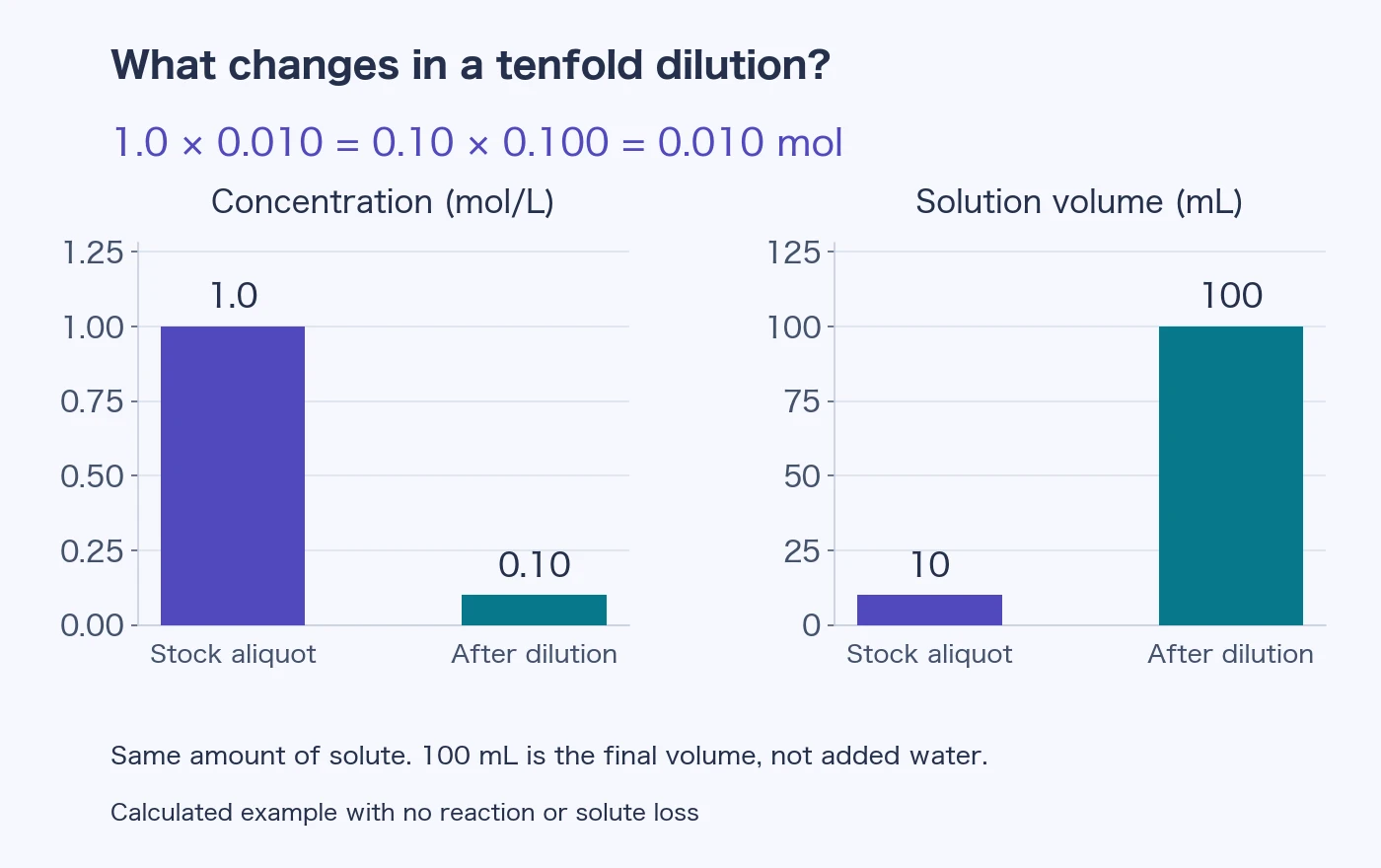
The calculation means diluting a 10 mL aliquot to a total of 100 mL. It does not mean adding 100 mL of water. Volumes are not necessarily exactly additive, so it also does not imply that precisely 90 mL of added water will always give the required final volume.
The dilution factor is V₂/V₁ = C₁/C₂ = 10. Concentration falls to one tenth. Dilution alone cannot produce a concentration higher than the stock.
Check the inputs and working in the tools
Calculate molarity from mass
Open Moles & Molarity, select “From mass and molar mass,” and enter:
| Field | Input |
|---|---|
| Mass m (g) | 5.844 |
| Molar mass M (g/mol) | 58.44 |
| Solution volume V | 500.0, with mL selected |
Select “Calculate.” Check 0.2 mol/L, 200 mmol/L, and V=0.5 L in the working. The numerical display omits trailing zeros. Restore notation appropriate to the precision of your given values when writing a report.
Calculate the required stock volume
In the dilution calculator, choose mol/L, enter stock concentration 1.0, target concentration 0.10, and final volume 100 mL. Select “Calculate” and check 10 mL of stock and a dilution factor of 10.
Practice: diluting only part of a solution
Take 50.00 mL from a 0.2000 mol/L solution and dilute it to 250.0 mL. C₂ = 0.2000 × 50.00 ÷ 250.0 = 0.04000 mol/L. The conserved amount is the 0.01000 mol in the aliquot. Do not include solute left behind in the original container.
Units and concentration types that cause confusion
| Notation | Meaning or conversion | What to check |
|---|---|---|
| 1 mol/L | 1000 mmol/L, or 1 mmol/mL | Unit prefixes |
| M | Often an abbreviation for mol/L in concentration notation | In this article’s equations, M denotes molar mass in g/mol |
| Mass percent | Solute mass / solution mass × 100 | Converting to mol/L also needs molar mass and solution density |
| mol/kg (molality) | Amount per kilogram of solvent | Denominator is solvent mass, not solution volume |
Molarity uses volume, so it can change with temperature-dependent volume changes. Record measurement conditions alongside the number.
FAQ
What is one mole?
One mole contains exactly 6.02214076×10²³ specified elementary entities. Specify which entities you mean. This follows the BIPM SI definition.
Can I calculate pH from molarity alone?
No: you also need the solute’s identity and the relevant dissociation or reaction conditions. IUPAC defines pH as −log₁₀ a(H⁺), using hydrogen-ion activity. The concentration form pH ≈ −log₁₀([H⁺]/(1 mol/L)) is an approximation when the activity coefficient can be treated as one. NaCl molarity is not [H⁺]. See the pH guide for calculation conditions.
Does C₁V₁=C₂V₂ work for any mixture?
It describes dilution with conserved solute amount and matching volume-based concentration units. Do not substitute reacting mixtures or mass-percent concentrations without checking the units and assumptions.
When should I round significant figures?
Keep extra digits during intermediate calculations and round the final result according to the problem or measurement conditions. The mL-to-L factor of 1000 is exact. See significant figures and calculation rules.
What was checked
On October 3, 2026, the definitions and conditions were compared with the listed references, and example masses, amounts, concentrations and dilution factors were recalculated. The plot uses the stated values. Calculator inputs and displayed results are also part of this check. For hands-on work with reagents, follow your institution’s laboratory procedures and supervisor’s instructions.