Unit conversion expresses the same quantity in another unit. Length and mass use factors; temperatures also need a zero-point adjustment. Temperature intervals do not use +32 or +273.15. Start with the kind of quantity, identify the unit definition, then choose the formula.
The unit converter supports length, weight (mass) and temperature. It has no area, volume, speed, fluid-ounce or dedicated temperature-interval mode.
Inches to cm and pounds to kg: conversion table
| Input unit | Converted quantity | Check first |
|---|---|---|
| 1 in | 2.54 cm | Screen size normally means diagonal |
| 1 ft | 0.3048 m | International foot |
| 1 mile | 1.609344 km | International mile, not nautical mile |
| 1 lb | 0.45359237 kg | Avoirdupois mass, not force |
| 1 oz | 28.349523125 g | Avoirdupois, not fluid or troy ounce |
| 1 t | 1000 kg | Metric tonne, not a US/UK ton |
NIST’s conversion tables distinguish different unit definitions. The lb and oz used here are avoirdupois. A precisely defined factor does not improve the precision of a measured input. Divide by the same factor for the reverse conversion.
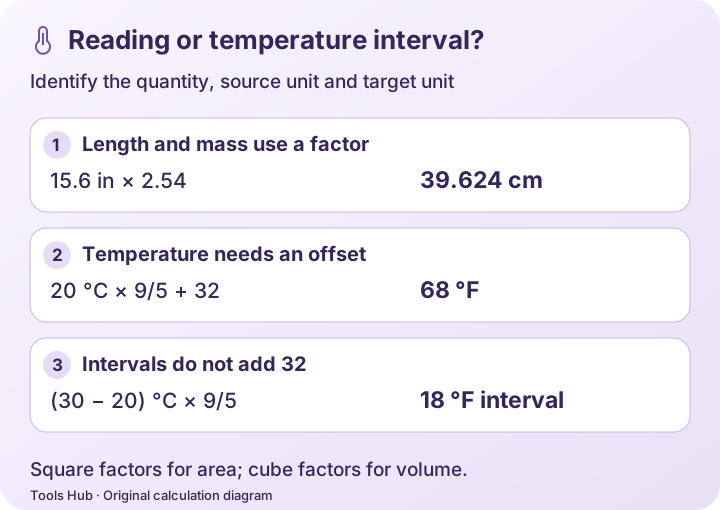
How many cm is a 15.6-inch screen?
15.6 in×2.54 cm/in = 39.624 cm. The inches cancel and centimeters remain. The reverse calculation is 39.624÷2.54 =15.6 in.
Screen sizes normally identify the display diagonal. For a 16:9 rectangular display, width is 39.624×16÷√(16²+9²), or about 34.5 cm. Other aspect ratios and product dimensions including bezels need separate checks.
5 feet 6 inches is not 5.6 feet
5 ft 6 in is(5×12+6)×2.54 = 167.64 cm. In contrast,5.6 ft×30.48 = 170.688 cm. The converter takes one number, so first combine mixed feet-and-inches notation into inches or decimal feet.
Ounces to grams: mass, volume and force
8 avoirdupois oz×28.349523125 = 226.796185 g. Fluid ounces measure volume; troy ounces use another mass definition. Before converting a recipe’s oz to grams, check whether the ingredient is specified by mass or volume.
As NIST’s mass guide explains, kg measures mass and weight as a force uses newtons. Converting mass to force requires gravitational acceleration. Converting mL to g requires density(g/mL)×volume(mL). At a specified density of 1.2 g/mL,250 mL is 300 g;1 mL does not universally equal 1 g.
Check the example with your own inputs
Enter 15.6 in to cm under length and 8 oz to g under weight. Confirm 39.624 cm and 226.796185 g. Do not use the oz option for fluid ounces.
Celsius, Fahrenheit and Kelvin: temperature or interval?
NIST’s temperature formulas account for the different zero points. Use K without a degree symbol.
| Conversion | Operation on the number | Example |
|---|---|---|
| °C to °F reading | ×9/5+32 | 20 °C→68 °F |
| °F to °C reading | (value−32)×5/9 | 68 °F→20 °C |
| °C to K reading | +273.15 | 20 °C→293.15 K |
| °C interval to °F interval | ×9/5 only | 10 °C interval→18 °F interval |
| °C interval to K interval | Same numerical value | 10 °C interval→10 K interval |
For a change from 20°C to 30°C, convert both endpoints and subtract:86−68 =18°F. Entering 10 as a temperature in the converter gives 50°F, so do not use that result for a 10-degree interval.
Ordinary thermodynamic temperatures have a lower limit of 0 K. The tool evaluates conversion formulas and does not validate all physical conditions. Check the unit, sign and measurement context separately, including negative inputs.
Area, volume and speed need different factors
| Conversion | Calculation | Result and reason |
|---|---|---|
| 2.5 m² to cm² | 2.5×100² | 25,000 cm²; square the factor |
| 0.002 m³ to cm³ | 0.002×100³ | 2000 cm³; cube the factor |
| 250 mL to L | 250÷1000 | 0.25 L;1 mL=1 cm³ |
| 36 km/h to m/s | 36×1000÷3600 | 10 m/s; convert distance and time |
These are manual examples, outside the unit converter’s three categories. Use the area and volume guide for geometric calculations, the byte conversion guide for bit/B and GB/GiB, or the data size guide for formulas involving seconds.
Calculator workflow and checks before recording a result
- Select a category, enter the value and choose source and target units. Results update automatically. There are 8 length,5 mass and 3 temperature units.
- Record the unit and check a reverse conversion. Standard displays round to at most 6 decimal places; large and very small values use exponential notation.
- For unsupported uses such as areas or temperature intervals, use the formulas above. See significant figures before rounding a measured result.
Check the example with your own inputs
Convert 20°C and 30°C separately to Fahrenheit. Check 68 and 86, then subtract to obtain the 18°F interval.
A favorite keeps a shortcut in the same browser. It does not save input values or measurement records. You can also return from the utility category.
Editorial verification and limits
Tools Hub editors checked NIST references, the arithmetic, supported units and display behavior on 8 November 2026. Examples are calculations from definitions and formulas, not empirical measurements or professional calibration certificates. For products use manufacturer dimensions; for measurements consider the required precision and uncertainty.
FAQ
Should I multiply or divide when converting units?
Arrange the factor so the original unit cancels and the desired unit remains. Inches to cm uses×2.54; cm to inches uses÷2.54. Temperature readings also need a zero-point correction.
Is a 15.6-inch screen 39.624 cm wide?
39.624 cm is normally the display diagonal. A 16:9 rectangle has a width of about 34.5 cm; check manufacturer dimensions for bezels and the whole product.
Is a 10°C temperature increase a 50°F increase?
No. It is an 18°F increase. The temperature reading 10°C is 50°F, but intervals do not add 32. Convert both endpoints separately if using this tool.
Can I convert oz or mL directly to grams?
The tool uses avoirdupois ounces for mass. Fluid ounces measure volume and troy ounces are different. Milliliters require a density to calculate grams.