Thermal efficiency and Carnot efficiency answer different questions. W/QH measures the fraction of supplied heat converted to work. The two-reservoir Carnot expression gives a theoretical ceiling. Match units and assumptions before comparing them.
Choose the quantity and calculator mode
| Goal | Inputs | Formula | Mode |
|---|---|---|---|
| Theoretical efficiency limit | Hot and cold temperatures in K | ηmax = 1−TC/TH | Carnot |
| Efficiency from a specified output | Heat and work in the same J or kW | η = W/QH | Actual engine |
| Two-reservoir consistency | Temperatures, heat and work rates | Ṡgen = Q̇C/TC−Q̇H/TH | Actual engine |
| Air-standard engine cycle | r, γ and diesel cutoff ratio rc | See example 3 | Otto / Diesel |
| Heating or refrigeration COP | Useful heat rate and work rate in kW | COP = useful heat/W | Heat pump / refrigerator |
J measures energy; kW measures energy per second. Dividing an energy in J by a power in kW does not give efficiency. One MW is 1000 kW.
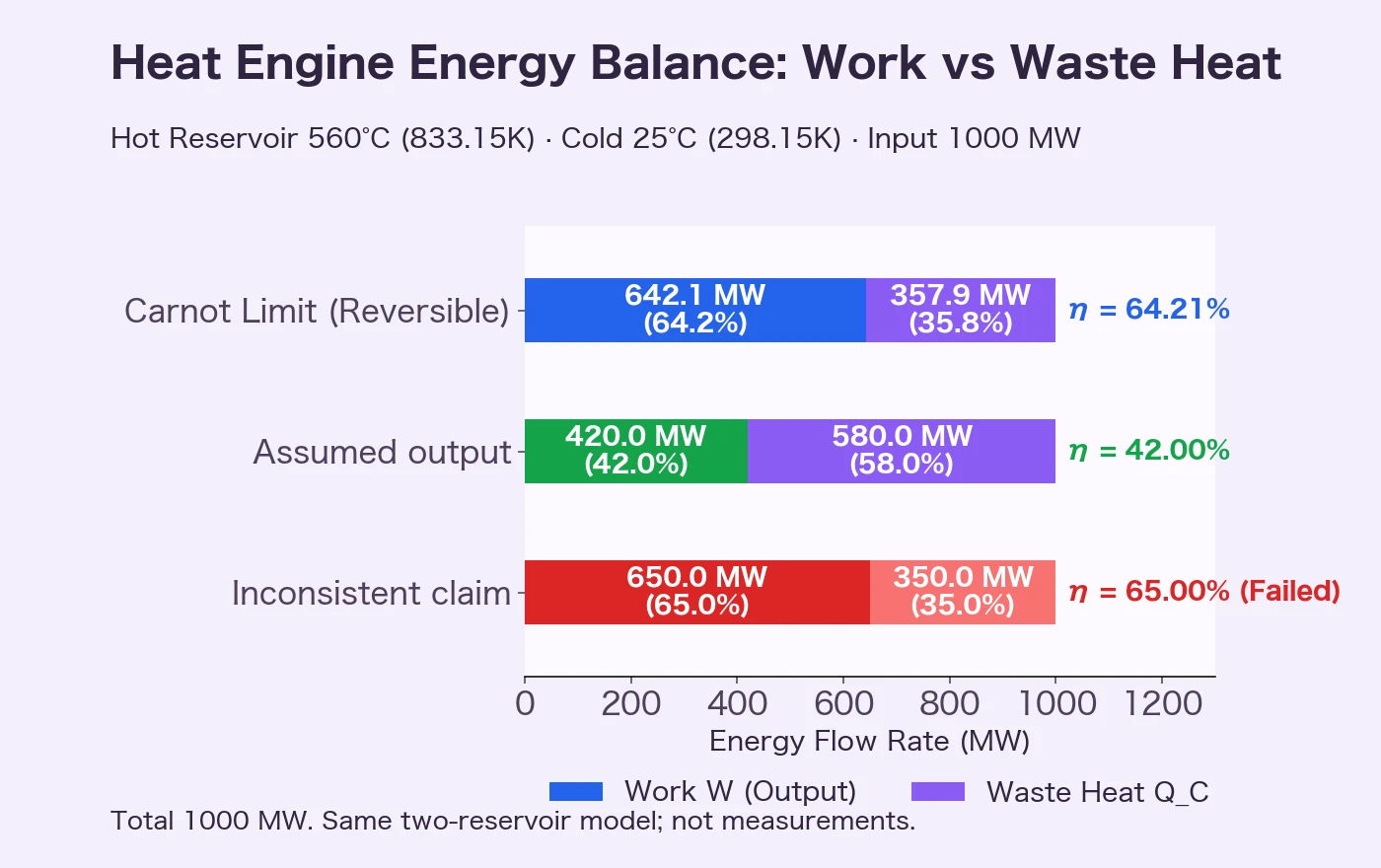
Example 1: 560°C, 25°C and 1000 MW
These are assumed inputs for a two-reservoir learning model, not measured plant data. The steam inlet temperature alone does not establish a real plant’s efficiency.
| Quantity | Calculation |
|---|---|
| Hot reservoir | 560+273.15 = 833.15 K |
| Cold reservoir | 25+273.15 = 298.15 K |
| Heat input rate | 1000 MW |
| Carnot efficiency | 1−298.15/833.15 ≈ 64.21% |
| Maximum work rate | 1000×0.642141… ≈ 642.14 MW |
| Minimum heat rejection | 1000−642.141… ≈ 357.86 MW |
Using 1−25/560 gives about 95.5%, which is wrong because Celsius is not an absolute temperature scale.
Assume an output of 420 MW
Efficiency is 42.00%, rejected heat is 580 MW, and efficiency relative to this Carnot limit is 65.41%. The entropy generation rate is
A positive value is consistent with the second law within these assumptions. It does not prove a real machine can be built or certify its safety or performance. Finite heat exchange, losses, materials and measurement uncertainty require separate analysis.
Reproduce the example without mixing MW and kW
- Open the heat engine calculator and choose the steam-power preset: 560°C, 25°C and 1000 MW. Check 64.21% and 642.14 MW.
- The Actual Engine panel uses kW. To represent the same scale, enter heat input 1,000,000 kW and work 420,000 kW at 560°C and 25°C.
- Entering 1000 kW and 420 kW gives the same 42% efficiency at one-thousandth of the scale, with entropy generation 0.7451 kW/K.
- Copy the calculation report with its conditions. A conditions link exposes values, units and modes to its recipient. Favorites save the tool, not its inputs.
Example 2: inputs inconsistent with the second law
Assume 300°C (573.15 K), 30°C (303.15 K), input 1000 kW and work 650 kW. The limit is 47.11%, below the specified 65%. Rejected heat is 350 kW, giving Ṡgen = 350/303.15−1000/573.15 ≈ −0.5902 kW/K. Those inputs contradict a steady cyclic two-reservoir model without additional heat or work interactions. Check boundaries and measurements before drawing conclusions about equipment.
Example 3: air-standard Otto and Diesel models
| Ideal-gas, constant-heat-capacity model | Inputs | Calculated efficiency |
|---|---|---|
| Otto | r=10.5, γ=1.40 | 1−1/r^(γ−1) ≈ 60.96% |
| Diesel | r=18, rc=2, γ=1.40 | 1−(rc^γ−1)/[γr^(γ−1)(rc−1)] ≈ 63.16% |
These are not real vehicle fuel-economy predictions. The Otto compression temperature ratio is 10.5^0.4 ≈ 2.5613. With a 25°C inlet, the calculated outlet is 763.68 K (490.53°C). Variable heat capacity, combustion, wall heat transfer and friction are excluded.
Example 4: when does heating COP equal cooling COP plus one?
The identity applies to one operating point and one system boundary where QH=QC+W, without uncounted heat flows or storage. It does not say that heating and cooling catalogue ratings measured at different temperatures and loads must differ by one.
Assume 20°C, 2°C, work input 1.2 kW and delivered heat 5.4 kW. Heating COP is 4.50. At that same operating point, extracted heat is 4.2 kW and the corresponding extraction COP is 3.50. The reversible two-reservoir heating limit is 293.15/(293.15−275.15) ≈ 16.29. Using room and outdoor air temperatures is a simplification, not a product rating including refrigerant temperatures, auxiliary power, defrost and part-load effects.
For an assumed electricity rate of 31 yen/kWh, the energy-only cost would be 1.2×1×31 = 37.2 yen per hour. Use your contract rate and operating duration in the electricity cost guide.
FAQ
Are efficiency and COP interchangeable?
No. Efficiency compares work output with heat input; heating COP compares delivered heat with input work. COP above one alone does not violate energy conservation.
Does a green consistency result validate equipment design?
It only checks the stated model. It does not certify real equipment feasibility, safety or performance. Keep the original data, assumptions and units; the heat calculator and unit converter can help with separate checks.
Corrections and checks on October 17, 2026
Corrected the OpenStax reference to section 4.5 and added NIST’s temperature reference. Distinguished assumed values from measurements, MW from kW, and model consistency from real feasibility. Independently recalculated the examples and corrected the compression temperature to 763.68 K. References support the formulas, not certification of this calculator.