When assigned to prepare “500 mL of 0.1 M Sodium Phosphate buffer (pH 7.4)” or “1 L of 50 mM Tris-HCl (pH 8.0)” for a wet-lab protocol, researchers frequently encounter practical obstacles: “The chemical shelf has dihydrate and dodecahydrate salts with vastly different molecular weights,” “How many milliliters of 1 M HCl titrant do I add to solid Tris base?”, or “Why did our enzyme assay fail when room-temperature Tris was transferred to a 4°C cold room?”
This guide breaks down: 1) Solving the Henderson-Hasselbalch equation for acid/base mole ratios, 2) Calculating analytical balance mass (g) accounting for hydration states, 3) Determining titrant volume (mL of 1.0 M HCl) from solid weak base (Tris), 4) Temperature coefficient compensation (ΔpKa/ΔT) for 4°C refrigeration, and 5) Evaluating Van Slyke buffer capacity β against unbuffered water, accompanied by step-by-step math and interactive verification on the Buffer Solution & Henderson-Hasselbalch Calculator. All worked examples represent theoretical dilute aqueous models.
Preparation Methods and Tool Tabs
Laboratory buffer preparation generally follows either dual-salt mixing (combining solid weak acid and conjugate base salts) or single-salt titration (dissolving solid weak base/acid and titrating with standardized HCl or NaOH):
| Buffer System | Starting Reagents | Key Calculation | Tool Mode / Tab |
|---|---|---|---|
| Sodium Phosphate (PB / PBS) | NaH₂PO₄ (acid) + Na₂HPO₄ (base) | Solve mole ratio from target pH; multiply by specific hydrate formula weights (2H₂O vs. 12H₂O) | Tab 1: “Dual Component (Weak Acid + Conjugate Base)” |
| Acetate Buffer | Acetic acid (CH₃COOH) + Sodium acetate (CH₃COONa·3H₂O) | pKa 4.76; ensures buffering capacity in acidic regime (pH 3.8–5.8) | Tab 1: “Dual Component (Weak Acid + Conjugate Base)” |
| Tris-HCl Buffer (Titration) | Solid Tris base + 1.0 M HCl titrant | Weigh total Tris base; calculate volume of 1.0 M HCl required to form conjugate acid TrisH⁺ | Tab 2: “Titration (Single Salt + Strong Acid/Base)” |
| HEPES / MES Buffer (Titration) | Solid free acid + 1.0 M NaOH titrant | Weigh free acid; calculate volume of 1.0 M NaOH required to generate conjugate base | Tab 2: “Titration (Single Salt + Strong Acid/Base)” |
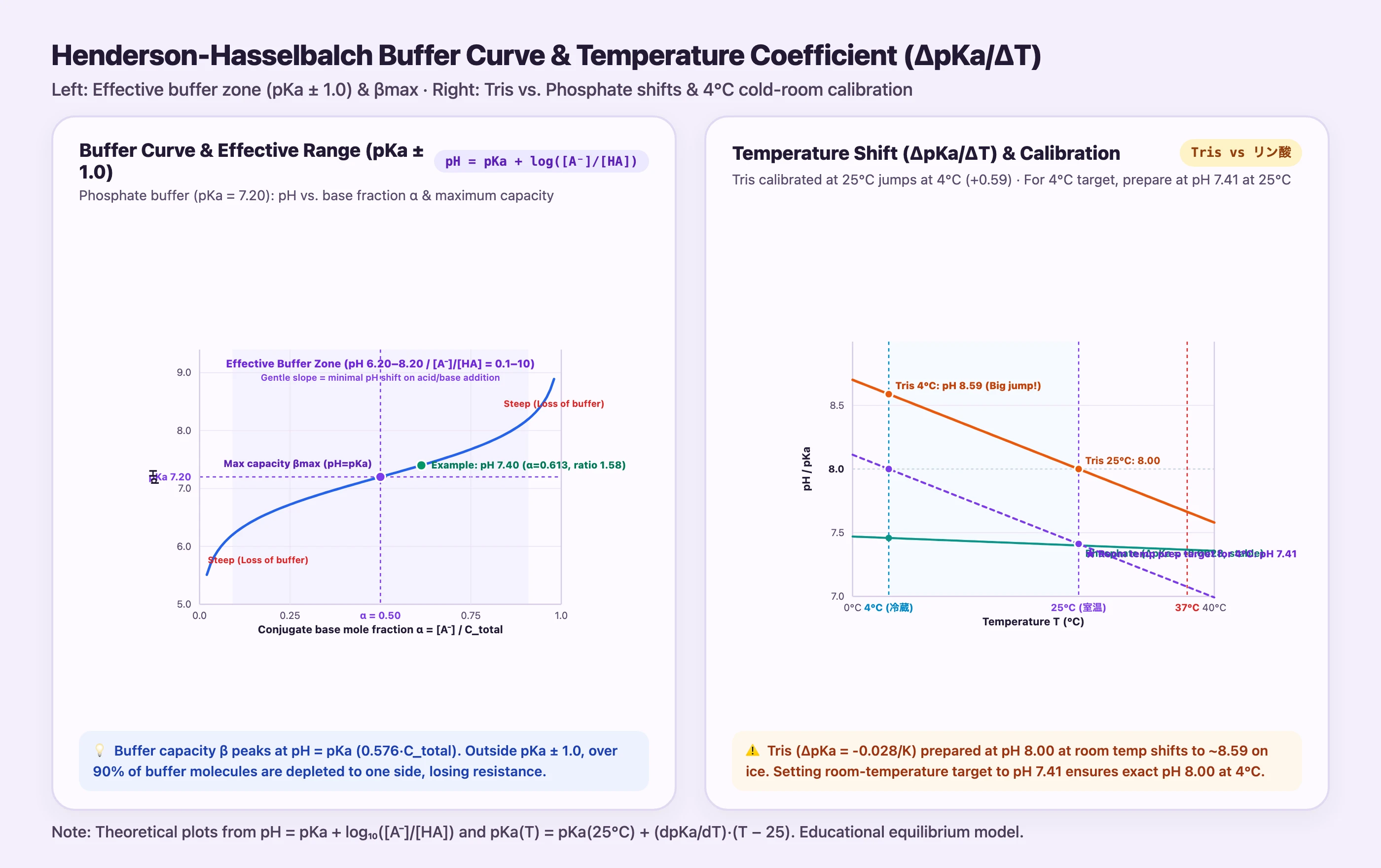
| 4°C Cold-Room Tris Buffer | Temperature coefficient ΔpKa/ΔT = -0.028 / K | Calibrating at 25°C causes pH to jump +0.59 at 4°C; back-calculate preparation target to pH 7.41 | Tabs 1 & 2: “Temperature & Drift Adjustment” |
| Buffer Capacity β & Resistance | Total concentration C_total, α_HA, α_A⁻ | Calculate Van Slyke capacity β; simulate pH response against unbuffered pure water | Tab 3: “Resistance & Capacity β” |
Fundamental Principles: Henderson-Hasselbalch Equation & Mole Ratio
For a monoprotic weak acid HA in aqueous equilibrium with its conjugate base A⁻:
Taking the negative common logarithm yields the Henderson-Hasselbalch equation:
To determine the required ratio of conjugate base to weak acid R:
Given target buffer concentration C_total [mol/L] and total volume V [L], total moles equal n_total = C_total × V [mol]. The individual quantities are distributed as:
Analytical balance mass m [g] is computed using the specific molar mass M [g/mol] printed on the reagent container:
For fundamental molar concentration relationships, refer to our Molarity and Dilution Calculation Guide.
Example 1: 0.1 M Sodium Phosphate Buffer (pH 7.40, 500 mL) via Dual Salt Mixing
We prepare 500 mL of 0.100 M Sodium Phosphate buffer (PB, pH 7.40, 25°C), utilizing the secondary dissociation equilibrium of phosphoric acid (pKa₂ = 7.200 at 25°C).
Reagents available on the lab shelf:
- Weak acid: Sodium phosphate monobasic dihydrate (NaH₂PO₄·2H₂O, M = 156.01 g/mol)
- Conjugate base: Sodium phosphate dibasic dodecahydrate (Na₂HPO₄·12H₂O, M = 358.14 g/mol)
- Calculate base-to-acid molar ratio R:
- Distribute total moles n_total across both species: n_total = 0.100 mol/L × 0.500 L = 0.0500 mol.
- Multiply by hydrate molar masses to obtain balance masses:
- Monobasic dihydrate (NaH₂PO₄·2H₂O, M = 156.01 g/mol):
- Dibasic dodecahydrate (Na₂HPO₄·12H₂O, M = 358.14 g/mol):
The Hydration Trap: Overlooking Formula Weight
If anhydrous dibasic sodium phosphate (Na₂HPO₄, M = 141.96 g/mol) were used instead, the required mass would be 0.030657 mol × 141.96 g/mol = 4.352 g.
If a researcher reads a textbook recipe specifying 4.352 g of anhydrous salt but weighs 4.352 g of the 12-hydrate from the shelf, only 4.352 ÷ 358.14 = 0.01215 mol of conjugate base is added. As a result, [A⁻]/[HA] collapses from 1.585 down to 0.628, driving the final buffer pH down from 7.40 to ~7.00. Always confirm the exact formula weight (FW) printed on your reagent bottle.
Example 2: 50 mM Tris-HCl Buffer (pH 8.00, 1000 mL) via Titration
In molecular biology and electrophoresis, Tris buffer (25°C, pKa = 8.060) is typically prepared by dissolving solid Tris base (M = 121.14 g/mol) and titrating with standardized 1.0 M HCl to pH 8.00.
Tris is an amine weak base B that accepts a proton from hydrochloric acid to generate conjugate acid BH⁺ (TrisH⁺):
- Calculate free base to conjugate acid ratio R:
- Weigh total Tris base for 1000 mL: n_total = 0.050 mol/L × 1.000 L = 0.050 mol.
- Calculate volume of 1.0 M HCl titrant needed: Every mole of HCl added converts one mole of Tris base into TrisH⁺. Thus, n_HCl equals the required moles of conjugate acid n_BH⁺: At titrant concentration C_HCl = 1.00 mol/L:
Practical Laboratory Protocol
- Add ~800 mL (80% of final volume) of deionized water to a beaker.
- Dissolve 6.057 g of Tris base using a magnetic stir plate until clear.
- Dispense ~24–25 mL of 1.0 M HCl while gently stirring.
- Immerse a calibrated pH electrode, and titrate dropwise with 1.0 M HCl (switching to 0.1 M HCl near endpoint) until the meter reads pH 8.00.
- Transfer quantitatively to a 1000 mL volumetric flask, rinse the beaker, and bring to the graduation mark with deionized water.
Example 3: Temperature Coefficients (ΔpKa/ΔT) — Avoiding 4°C Assay Failures
Protein purification and enzyme kinetics are routinely performed in 4°C cold rooms or on ice to suppress proteolytic degradation.
However, as established by Good et al. (Biochemistry 1966), biological buffers exhibit marked temperature coefficients (ΔpKa/ΔT):
| Buffer System | pKa at 25°C | ΔpKa/ΔT (per K) | Predicted pKa at 4°C | Predicted pKa at 37°C |
|---|---|---|---|---|
| Tris | 8.06 | -0.028 | 8.65 (+0.59) | 7.72 (-0.34) |
| HEPES | 7.55 | -0.014 | 7.84 (+0.29) | 7.38 (-0.17) |
| Phosphate (pKa₂) | 7.20 | -0.0028 | 7.26 (+0.06) | 7.17 (-0.03) |
| Acetate | 4.76 | +0.0002 | 4.76 (negligible) | 4.76 (negligible) |
Why Cold-Room Assays Fail
When a Tris buffer adjusted to pH 8.00 at 25°C is cooled to 4°C, dissociation shifts and the actual pH rises to 8.59–8.65. A drift of over 0.6 pH units frequently shifts enzymes far from their optimal pH or causes target proteins to precipitate at their isoelectric point.
Solution: Back-Calculating Room-Temperature Target for 4°C
To achieve pH 8.00 at 4°C, Tris pKa at 4°C is 8.06 − 0.028 × (4 − 25) = 8.648. The required molar ratio at 4°C is:
When measured at ambient room temperature (25°C, pKa = 8.060), this specific ratio yields:
Titrant volume required:
By adjusting the buffer to pH 7.41 at 25°C (adding 40.82 mL of 1.0 M HCl), it automatically reaches exactly pH 8.00 when placed in the 4°C cold room.
Example 4: Van Slyke Buffer Capacity β and Strong Acid Challenge
A buffer’s ability to resist pH changes upon addition of external acid or base is quantified by Van Slyke buffer capacity (β):
- Maximum Buffer Capacity: At pH = pKa (α_HA = α_A⁻ = 0.50), the product α_HA·α_A⁻ reaches its maximum 0.25, yielding β_max = 0.5756 × C_total.
- Effective Buffer Range: Across |pH − pKa| ≤ 1.0, β remains above 33% of its peak. Beyond 1.5 units, capacity drops precipitously.
Adding 1.0 mL of 1.0 M HCl to 500 mL of 0.1 M Phosphate Buffer (pH 7.40)
- Initial state: HA = 0.019343 mol, A⁻ = 0.030657 mol, β = 2.3026 × 0.100 × 0.3869 × 0.6131 ≈ 0.0546 mol/(L·pH).
- Adding 1.0 mL of 1.0 M HCl (0.00100 mol H⁺): New HA = 0.019343 + 0.00100 = 0.020343 mol New A⁻ = 0.030657 − 0.00100 = 0.029657 mol The pH drops by only 0.04 units.
Contrast with Unbuffered Pure Water
Adding 1.0 mL of 1.0 M HCl to 500 mL of neutral pure water (pH 7.00) results in [H⁺] ≈ 0.00100 ÷ 0.501 ≈ 0.001996 mol/L:
Unbuffered water crashes from pH 7.00 to pH 2.70—a collapse of 4.30 pH units (a 20,000-fold surge in acidity). For logarithmic relationships, see our pH and Hydrogen Ion Concentration Guide.
Interactive Verification in the Buffer Calculator
Test each worked example directly in the Buffer Solution & Henderson-Hasselbalch Calculator:
- Example 1 (Sodium Phosphate Dual-Salt Mix):
Click preset “Sodium Phosphate (PB) (pH 7.4, 0.1M, 500mL)” to populate Tab 1 with
pH = 7.40,C = 0.1 mol/L,V = 500 mL,Acid = NaH₂PO₄·2H₂O (156.01), andBase = Na₂HPO₄·12H₂O (358.14). It confirms Acid mass: 3.018 g, Base mass: 10.979 g, mole ratio 1.5849, and β = 0.0546 mol/(L·pH). - Example 2 (Tris-HCl Titration): Click preset “Tris-HCl Buffer (pH 8.0, 50mM, 1000mL)” to open Tab 2. It immediately outputs Tris base mass: 6.057 g and 1.0 M HCl volume: 26.72 mL.
- Example 3 (4°C Temperature Compensation):
Expand “Temperature & Drift Adjustment” in Tab 2 and set
Assay Temperature = 4°C. The tool updates withRoom-temp (25°C) prep target = pH 7.41and1.0 M HCl volume = 40.82 mL. - Example 4 (pH Resistance Simulation):
In Tab 3, input
Added Reagent = 1.0 M HClandVolume = 1.0 mL. The graph demonstrates the buffer holding steady at pH 7.40 → 7.36 (ΔpH = -0.04) while pure water collapses from pH 7.00 → 2.70 (ΔpH = -4.30).
To document recipes for laboratory notebooks or audit reports, click “Copy Preparation Protocol (Markdown)” at the bottom of the tool.
Common Mistakes & Operational Boundaries
- Ignoring Reagent Hydration State: Reagents exist as anhydrous, monohydrates, dihydrates, heptahydrates, or dodecahydrates. Never rely on memorized molecular weights; read the container label FW/MW.
- Neglecting Temperature Shifts in Good Buffers: Tris calibrated to pH 8.00 at 25°C shifts to ~8.59 at 4°C. Back-calculate room-temperature targets when preparing buffers for cold-room assays.
- Operating Outside |pH − pKa| ≤ 1.0: Buffering capacity drops steeply when pH deviates by more than 1 unit from pKa. If the required ratio exceeds 10:1 or 1:10, choose a conjugate pair with a closer pKa.
- Adjusting pH After Full Volume Dilution: Adding large volumes of titrant after bringing a solution to final volume dilutes the buffer below intended concentration. Always adjust pH at ~80% volume before final volumetric flask calibration.
- Ionic Strength and Activity Deviations: The Henderson-Hasselbalch equation assumes activity coefficients near unity (dilute solutions, < 0.1 M). In high ionic strength buffers (> 0.5 M) or high NaCl backgrounds, Debye-Hückel corrections and physical electrode measurements are required.
Frequently Asked Questions (FAQ)
Can I skip pH meter verification if I weigh the calculated masses precisely?
No. Minor reagent hygroscopy, atmospheric CO₂ absorption, temperature differences, and ionic strength shifts cause small offsets. Standard laboratory protocol requires dissolving in ~80% final volume, verifying and fine-tuning with a calibrated pH meter, and bringing to mark in a volumetric flask.
Does “0.1 M buffer” refer to the acid or base concentration?
It refers to the total buffer concentration (C_total = [HA] + [A⁻]), the sum of both conjugate forms. In a 0.1 M phosphate buffer, [H₂PO₄⁻] + [HPO₄²⁻] = 0.1 mol/L.
How do I select the best buffer for a target pH?
Select a buffer system whose pKa is closest to your target pH (ideally |pH − pKa| ≤ 0.5). For pH 7.4, choose Phosphate (pKa 7.20) or HEPES (pKa 7.55); for pH 8.0, choose Tris (pKa 8.06); for pH 5.0, choose Acetate (pKa 4.76). Also check compatibility (e.g., avoid phosphate when calcium or magnesium precipitates may form).