Guide to Faraday's Law of Electrolysis, Nernst Equation & Cell Potential: Formulas & Worked Examples
Master electrochemistry calculations from Faraday's law of electrolysis (Q = It, m = MIt/zF, STP gas volume) to the Nernst equation (E = E° − (RT/nF)ln Q), concentration cells, standard cell EMF E°cell, Gibbs free energy ΔG° = −nFE°, and equilibrium constant K with step-by-step worked examples.
Interactive Companion Tool
Electrochemistry, Nernst Equation & Faraday's Law Calculator
Quantitative electrochemistry rests on three foundational equations: (1) Faraday's law of electrolysis (Q = It, n(e⁻) = Q/F, m = MIt/(zF)), where product moles scale as 1/z with half-reaction electron count; (2) the Nernst equation (E = E° − (0.05916/n)log₁₀Q at 25 °C) for non-standard concentrations and concentration cells; and (3) the thermodynamic bridge ΔG° = −nFE°cell = −RT ln K.
“Why does passing the exact same electric current produce different molar amounts of silver (Ag), copper (Cu), and oxygen gas (O2)?” “When should I use F=96,500 C/mol versus the exact SI value F=96,485.33 C/mol?” “Which ion concentration goes in the numerator of log10Q in the Nernst equation?”
From introductory electrolysis and lead-acid battery problems to university physical and analytical chemistry lab reports on Daniell cells, concentration cells, and Gibbs free energy (ΔG∘), every electrochemistry calculation follows three core principles:
Faraday’s Law of Electrolysis (Q=It,n(e−)=Q/F): First find the moles of electrons transferred, n(e−), then divide by the half-reaction electron stoichiometry z (nproduct=n(e−)/z) to determine deposited mass or evolved gas volume.
The Nernst Equation (E=E∘−n0.05916log10Q at 25∘C): Every tenfold increase in the reaction quotient Q=[Cathode reduction reactants][Anode oxidation products] lowers cell potential by n59.16 mV.
The Thermodynamic Bridge (ΔG∘=−nFEcell∘=−RTlnK): Electrode potential E∘ [V = J/C] is an intensive property (unchanged when scaling reaction coefficients), whereas Gibbs energy ΔG∘ [J/mol] is extensive (proportional to transferred electrons n).
This guide provides a complete formula and unit alignment reference, compares the two Faraday constant conventions, visualizes 1/z stoichiometric scaling and Nernst potential slopes, and walks through four worked examples verified with hand arithmetic and our free browser calculator.
The Essentials: Core Formulas, Units & Faraday Constant Conventions
Keeping units consistent across Coulombs (C), Amperes (A), Volts (V = J/C), and Joules (J) eliminates arithmetic errors.
1. Summary of Fundamental Equations
Quantity / Law
Formula
Variables & Units
Key Rules & Scope
Electric Charge Q
Q=I×t
Q: Charge [C] I: Current [A] t: Time [s]
Always convert minutes (×60) and hours (×3600) to seconds [s] (1 mAh=3.6 C)
Moles of Electrons n(e−)
n(e−)=FQ=FI⋅t
n(e−): Electron moles [mol] F: Faraday constant [C/mol]
Identical across all electrolytic cells connected in series
Deposited Mass m
m=M⋅zn(e−)⋅100η=z⋅FM⋅I⋅t⋅100η
m: Mass [g] M: Molar mass [g/mol] z: Electrons per formula unit η: Current efficiency [%]
Divide n(e−) by z (z=1 for Ag+, z=2 for Cu2+, z=3 for Al3+)
STP Gas Volume VSTP
VSTP=22.4 [L/mol]×zgasn(e−)
zgas: Electrons per mole of gas
zgas=2 for H2,Cl2; zgas=4 for anode O2 evolution
The Faraday constant F represents the electric charge carried by one mole of electrons (F=e⋅NA). Depending on your curriculum or analytical setting, two values are used:
Convention
Value of F
Basis / Definition
When to Use
High-School / Exam Standard
96,500 C/mol (9.65×10⁴ C/mol)
Rounded to 3 significant figures
High-school chemistry and entrance exams where problem times (193 s, 965 s, 1,930 s) are engineered to divide cleanly by 965
Exact SI / CODATA Value
96,485.33212 C/mol
Exact 2019 SI definition e×NA e=1.602176634×10⁻¹⁹ C NA=6.02214076×10²³ mol−1
University physical/analytical chemistry labs, potentiometry, Nernst slopes (59.16 mV/dec), and thermodynamic ΔG∘/K derivations
Practical Tip:
The two values differ by 0.015%. You can switch between 96,500 C/mol and 96,485.33212 C/mol with a single click at the top of our Electrochemistry Calculator.
Visual Guide: 1/z Stoichiometry & Nernst Slopes
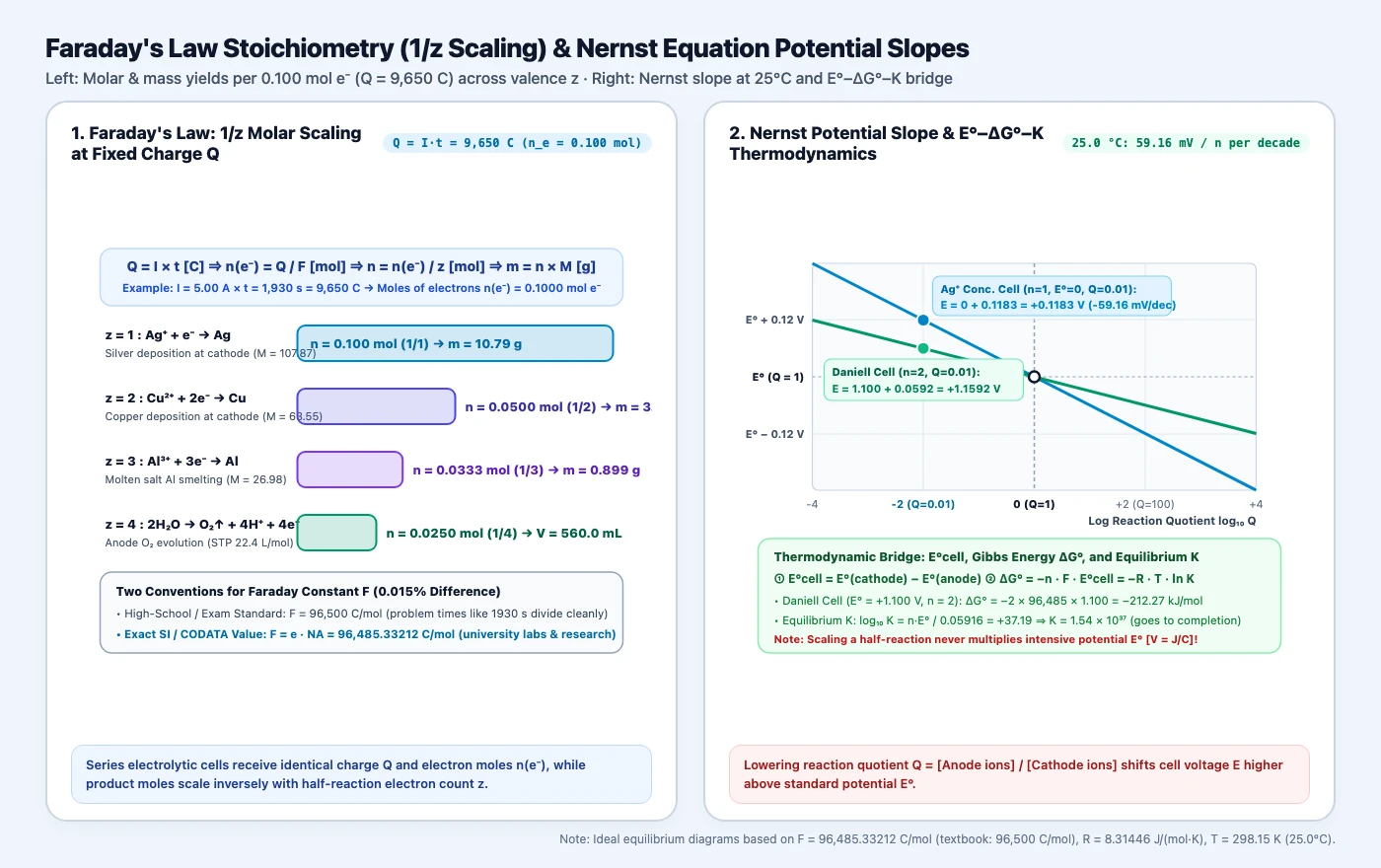
Figure 1 illustrates how a fixed electric charge distributes across half-reactions of different valence z (left) and how the Nernst equation shifts cell voltage across log10Q (right).
Figure 1: Left — Molar and mass yields per 0.100 mol e⁻ (Q = 9,650 C) as a function of electron number z. Right — Nernst potential slopes at 25.0 °C (−59.16 mV/n per decade) and the thermodynamic bridge connecting E°cell, ΔG°, and K. View full size image
1. Why Product Moles Scale as 1/z
Passing 5.00 A for 1,930 s delivers Q=9,650 C, which corresponds to n(e−)=0.1000 mol of electrons (at F=96,500 C/mol).
Thus, a one-electron transfer (n=1) shifts by −59.16 mV per decade of Q, whereas a two-electron transfer (n=2, Daniell cell) shifts by −29.58 mV per decade.
Four Step-by-Step Worked Examples
Example 1: Aqueous CuSO₄ Electrolysis (Cathode Copper Mass & Anode O₂ Volume)
Problem:
An aqueous CuSO4 solution is electrolyzed using inert platinum electrodes with a steady current of 5.00 A for 32 min 10 s (1,930 s). Using F=96,500 C/mol and M(Cu)=63.55 g/mol, calculate the mass of copper deposited at the cathode and the volume of O2 gas evolved at the anode at STP (22.4 L/mol).
Step-by-Step Solution
Compute total electric charge Q and moles of electrons n(e−):
Q=I×t=5.00 A×1,930 s=9,650 Cn(e−)=96,500 C/mol9,650 C=0.1000 mol e−
Example 2: Chlor-Alkali Brine Electrolysis Using Exact CODATA F
Problem:
In a chlor-alkali membrane cell electrolyzing saturated aqueous NaCl, a current of 10.0 A is passed for 1.00 h at 100% Faradaic efficiency. Using the exact CODATA Faraday constant F=96,485.33212 C/mol, find the mass of NaOH (M=40.00 g/mol) produced and the STP volume of Cl2 gas evolved.
Step-by-Step Solution
Convert time to seconds and find Q and n(e−):
t=1.00 h×3,600 s/h=3,600 sQ=10.0 A×3,600 s=36,000 C(10,000 mAh)n(e−)=96,485.33212 C/mol36,000 C≈0.373114 mol e−
Mass of NaOH formed (z=1 mole of OH− per mole of e−):
m(NaOH)=0.373114 mol×40.00 g/mol≈14.925 g
STP volume of Cl2 evolved at the anode (2Cl−→Cl2↑+2e−,zgas=2):
n(Cl2)=20.373114 mol≈0.186557 molV(Cl2)=0.186557 mol×22.4 L/mol≈4.1789 L=4,178.9 mL
Example 3: Non-Standard Daniell Cell Potential via the Nernst Equation
Problem:
A Daniell cell (-) Zn(s)∣Zn2+(0.010 M)∥Cu2+(1.00 M)∣Cu(s) (+) operates at 25.0∘C (298.15 K), with standard potential Ecell∘=+1.100 V. Calculate its cell potential E and Gibbs free energy change ΔG.
Step-by-Step Solution
Determine reaction quotient Q for Zn(s)+Cu2+(aq)→Zn2+(aq)+Cu(s) (n=2):
Q=[Cu2+][Zn2+]=1.000.010=0.010=10−2⟹log10Q=−2.00
Apply the Nernst equation at 25.0∘C:
E=Ecell∘−n0.05916 Vlog10Q=1.100−20.05916×(−2.00)=1.100+0.05916≈+1.1592 V
Calculate non-standard Gibbs free energy ΔG:
ΔG=−nFE=−2×96,485.33 C/mol×1.15916 V≈−223.68 kJ/mol
Example 4: Ag⁺ Concentration Cell & Standard Equilibrium Constant K
Problem:
(1) Find the EMF of a silver concentration cell (-) Ag∣Ag+(0.0010 M)∥Ag+(0.100 M)∣Ag (+) at 25.0∘C.
(2) For the Daniell cell (Ecell∘=+1.100 V,n=2), calculate ΔG∘ and the thermodynamic equilibrium constant K at 25.0∘C.
Choose the Faraday Constant Convention: Use the top selector (#ec-f-mode) to pick either F = 96,500 C/mol (textbook rounded) or F = 96,485.33212 C/mol (SI/CODATA exact).
Pick Your Calculation Tab:
Faraday’s Law Tab: Solve in 4 directions for deposited mass m, required current I, electrolysis time t, or ionic valence z, while simultaneously reading charge Q (C & mAh), n(e−), and STP gas volume.
Nernst Equation Tab: Compute non-standard potential E, standard potential E∘, or reaction quotient Q with an interactive SVG plot of E vs. log10Q.
Standard EMF, ΔG° & K Tab: Select cathode and anode half-cells to compute Ecell∘, ΔG∘, equilibrium constant K, and IUPAC line notation.
Forgetting to Convert Minutes or Hours to Seconds: Since 1 A=1 C/s, multiplying amperes by minutes underestimates charge Q by a factor of 60.
Using z=2 Instead of z=4 for Anode O2 Evolution: Oxidizing water (2H2O→O2+4H++4e−) transfers 4 electrons per O2 molecule.
Misinterpreting Lead-Acid Battery Electrode Mass Changes: During discharge, both the Pb anode (+48.0 g/mol e−) and the PbO2 cathode (+32.0 g/mol e−) gain mass as insoluble PbSO4 precipitates onto both plates.
Multiplying E∘ by Stoichiometric Coefficients: Electrode potential E∘ [V = J/C] is intensive and never scales when balancing half-reactions.
Scope & Real-World Deviations (Overpotential & Activity): Replacing thermodynamic activities ai=γici/c∘ with molar concentrations assumes dilute ideal solutions (γi≈1), and equilibrium Nernst potentials exclude activation overpotential (η) and internal ohmic drop (IRint).
Should I use F = 96,500 C/mol or F = 96,485.33212 C/mol for the Faraday constant?
Use F = 96,500 C/mol (9.65 × 10⁴ C/mol) when solving introductory or high-school chemistry exam problems where electrolysis durations (such as 193 s or 1,930 s) are specifically chosen to divide cleanly by 965. Use the exact 2019 SI / CODATA constant F = e · NA = 96,485.33212 C/mol for university physical chemistry, analytical chemistry lab reports, and research.
Why do we divide moles of electrons by z = 4 when calculating anode oxygen (O₂) evolution?
During the electrolysis of aqueous sulfate, nitrate, or hydroxide solutions with inert electrodes (Pt or C), water is oxidized at the anode via 2H₂O → O₂ + 4H⁺ + 4e⁻ (or 4OH⁻ → O₂ + 2H₂O + 4e⁻ in base). Generating 1 mole of O₂ molecules requires transferring 4 moles of electrons (z = 4), so n(O₂) = n(e⁻) / 4.
If I double the stoichiometric coefficients of a half-reaction, do I also double E°?
No. Standard Gibbs free energy ΔG° [J/mol] is an extensive property that scales with molar quantity, whereas standard electrode potential E° = −ΔG° / (nF) [V = J/C] is an intensive property representing energy per unit electric charge. Doubling a half-reaction doubles both ΔG° and n, leaving their ratio E° unchanged.
How does a concentration cell generate voltage when its standard cell potential E°cell is 0 V?
Because both half-cells use the identical electrode/ion couple, E°cell = 0 V. However, the spontaneous thermodynamic drive to equalize concentrations (entropy of mixing, ΔG < 0) oxidizes metal in the dilute half-cell (anode) and reduces ions in the concentrated half-cell (cathode), generating E = −(0.05916 / n) log₁₀(C_dilute / C_conc) > 0 V at 25 °C.
International definition of the Nernst equation relating equilibrium electrode potential E to standard potential E°, temperature T, and reaction quotient Q.
Thermodynamic treatment of intensive electrode potentials vs. extensive Gibbs free energies, concentration cells, and ionic activity coefficients.
For our approach to creating, checking and updating articles, read our editorial policy.
Verification Scope & Citation Formats
Formula & spec verified100% client-side
Companion tool QA verification: Checked November 10, 2026 via independent calculation and Playwright tests in both languages: CuSO₄ electrolysis (5.00 A, 1930 s, F=96,500) gives Q=9,650 C, n(e⁻)=0.1000 mol, 3.178 g Cu, and 560.0 mL STP O₂; brine electrolysis (10.0 A, 1.00 h, F=96,485.33) gives 14.92 g NaOH; Daniell cell Nernst ([Zn²⁺]=0.010 M, [Cu²⁺]=1.00 M, 25°C) gives E=+1.1592 V and ΔG=-223.68 kJ/mol; Ag⁺ concentration cell (0.0010 M / 0.100 M) gives E=+0.1183 V; standard Daniell thermodynamics (E°=+1.100 V, n=2) gives ΔG°=-212.27 kJ/mol and K=1.54×10³⁷. Applies to stated ideal models excluding overpotential and internal resistance.
All worked examples and tables in this guide are verified under their stated assumptions, units, and standard editions. You can copy the APA 7th or BibTeX citation below for lab reports or technical documentation.
APA 7th Edition
Tools Hub Editorial Team. (2026). Guide to Faraday's Law of Electrolysis, Nernst Equation & Cell Potential: Formulas & Worked Examples. Tools Hub. https://the-tools-hub.net/en/blog/electrochemistry-guide/
BibTeX (@misc)
@misc{tools_hub_electrochemistry_guide_2026,
  author = {{Tools Hub Editorial Team}},
  title = {Guide to Faraday's Law of Electrolysis, Nernst Equation & Cell Potential: Formulas & Worked Examples},
  year = {2026},
  url = {https://the-tools-hub.net/en/blog/electrochemistry-guide/}
}
Try it in your browser
Electrochemistry, Nernst Equation & Faraday's Law Calculator
Calculate electrolysis mass, current, time, valence z, and STP gas volume via Faraday's Law (Q = It, m = MIt/(zF)), solve non-standard cell potentials and concentration cells with the Nernst equation (E = E° − (RT/nF)ln Q), and determine standard cell EMF E°cell, Gibbs free energy ΔG° = −nFE°, and equilibrium constant K with a 1-click toggle between textbook F = 96,500 C/mol and exact CODATA F = 96,485.33212 C/mol.
Only with your consent, a random browser ID and tool/learning events are sent to measure return visits. This is pseudonymous measurement. Inputs, answers, keys, files and search terms are excluded. Consent expires after 90 days. Declining does not limit any feature.