“How do I choose the correct gas constant when computing osmotic pressure in a chemistry lab?” “Why is saline safely infused intravenously while pure water causes fatal hemolysis?” “Why do biochemists use membrane osmometry rather than freezing point depression to measure protein molecular weight?”
Osmotic pressure calculations across chemistry, biology, pharmacology, and chemical engineering resolve into three core principles:
- Van ’t Hoff’s law shares the identical mathematical structure of the ideal gas law (), scaling directly with total solute particle count (molarity and dissociation factor ).
- Biological tonicity benchmarks against human blood plasma (): hypotonic media drive water inward to burst red blood cells (hemolysis), while hypertonic media draw water outward to shrivel them (crenation).
- Macromolecular molar mass determination benefits from superior colligative sensitivity: while freezing point depression yields an undetectable temperature drop (), osmometry generates centimeters of directly measurable hydrostatic head ().
This guide walks through formula derivations, unit matching tables, the van ’t Hoff factor , erythrocyte tonicity models, and four practical worked examples (glucose, normal saline, protein osmometry, and reverse osmosis seawater desalination) verified with step-by-step arithmetic and our free browser calculator.
The Essentials: Formulas & Unit Matching Reference
When a pure solvent and a solution are separated by a semipermeable membrane (permeable to solvent molecules but impermeable to solute particles), solvent spontaneously diffuses into the solution to lower its chemical potential. Osmotic pressure () is the precise excess hydrostatic pressure that must be applied to the solution to halt this net solvent inflow.
In dilute solutions, osmotic pressure follows van ’t Hoff’s equation:
Multiplying both sides by solution volume yields the familiar gas-law equivalent:
Core Equations at a Glance
| Target Quantity | Formula | Application & Notes |
|---|---|---|
| Osmotic Pressure | Calculates pressure from molarity , factor , and temperature | |
| Total Osmolarity | Expressed in ; used for physiological tonicity classification vs. plasma | |
| Polymer Molar Mass | Back-calculates from dissolved mass , volume , and | |
| Hydrostatic Head | Converts osmotic pressure to U-tube column height given density and gravity |
Gas Constant and Pressure Unit Alignment
The single most frequent arithmetic pitfall is unit mismatch. Select the value of that matches your required pressure unit:
| Required Pressure Unit | Gas Constant Value & Unit | Concentration Unit | Volume Unit |
|---|---|---|---|
| (Kilopascals) | |||
| (Pascals, ) | () | () | |
| (Standard Atmospheres) |
Pressure Conversion Equivalents:
Theoretical Visual Guide: Factor i Slopes & Tonicity Scale
Because osmotic pressure depends strictly on the number of dissolved particles rather than their chemical identity, it is classified as a colligative property.
1. The Role of the Van ’t Hoff Factor
When dissolved in water:
- Non-electrolytes (glucose, sucrose, urea) do not dissociate: .
- Strong electrolytes dissociate into separate ions:
- ( particles )
- ( particles )
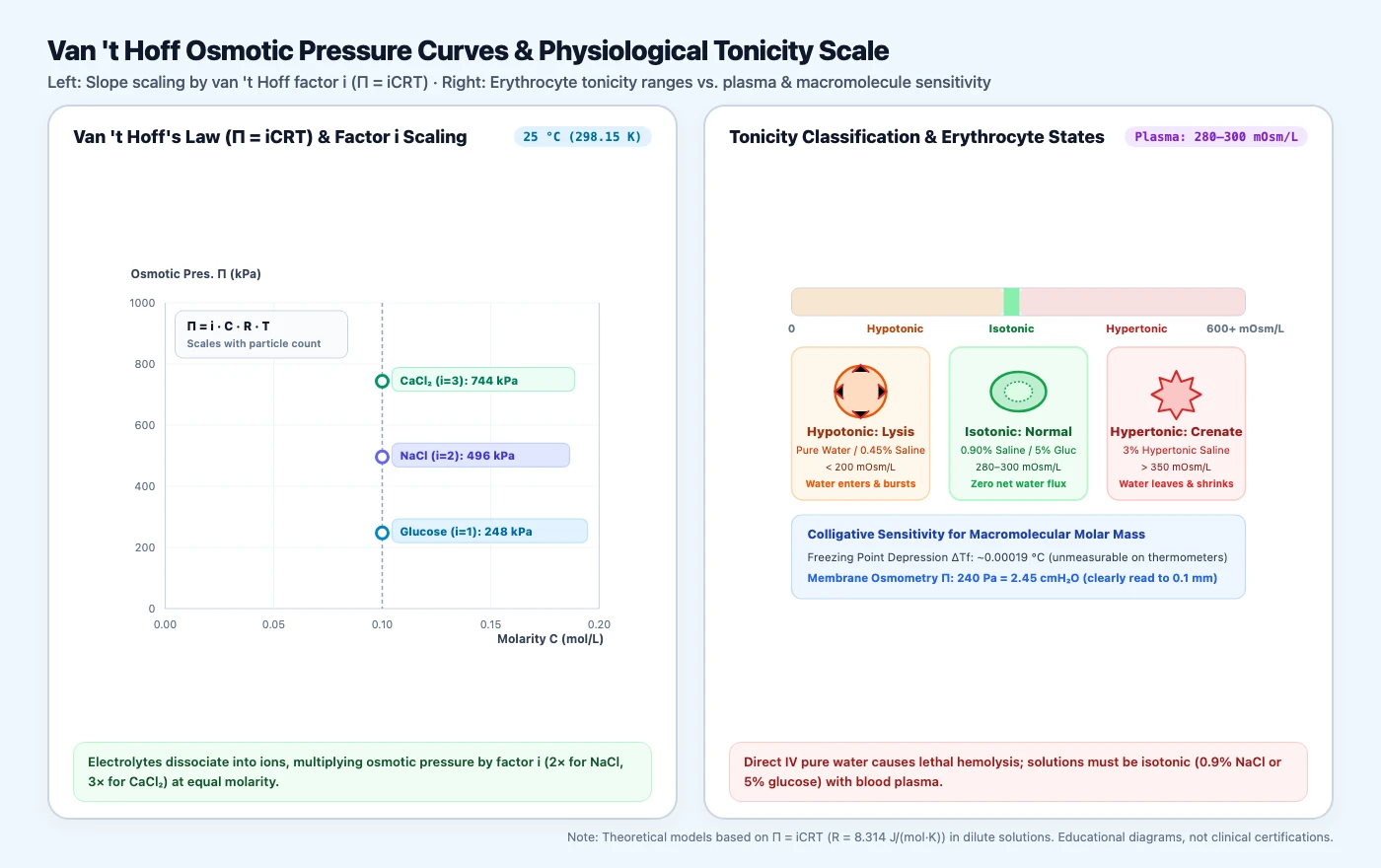
As shown in the left panel of Figure 1, at concentration and , generates roughly double the osmotic pressure () and generates triple the pressure () compared to non-dissociating glucose ().
2. Biological Tonicity & Erythrocyte Integrity
Normal human blood plasma maintains an osmolarity of approximately (roughly at ).
- Isotonic ():
Intracellular and extracellular osmotic pressures are balanced, resulting in zero net water movement. Red blood cells maintain their natural biconcave disc shape (e.g., normal saline, glucose). - Hypotonic ():
Lower external osmolarity causes water to rush into the erythrocytes through aquaporins. Cells swell into spheres and rapidly rupture, releasing hemoglobin into the bloodstream (hemolysis). Pure water and saline are hypotonic. - Hypertonic ():
Higher external osmolarity pulls water out of the erythrocytes, causing dehydration and cellular shrinkage into spiky crenated forms (crenation), impairing microvascular circulation ( hypertonic saline).
4 Practical Worked Examples
Step-by-step arithmetic for standard laboratory and clinical calculations.
Example 1: Non-Electrolyte Osmotic Pressure (Glucose)
Problem:
A solution is prepared by dissolving of D-glucose (, molar mass ) in water to a total volume of . Calculate its osmotic pressure at in both and .
Step-by-Step Solution
- Calculate molarity :
- Convert temperature to Kelvin:
- Substitute into van ’t Hoff’s equation ( for glucose): (Rounding to 3 significant figures yields ; using exact yields ).
- Convert to atmospheres:
Verify with the Osmotic Pressure Calculator glucose preset
Example 2: Normal Saline Tonicity & Osmolarity
Problem:
Medical normal saline is a aqueous solution (formula weight ). Determine its total osmolarity () and osmotic pressure at human body temperature (), assuming complete dissociation (), and evaluate its physiological tonicity.
Step-by-Step Solution
- Convert weight/volume percentage to molarity : represents of per of solution. In (), there is of .
- Calculate osmolarity: Because dissociates into and ():
- Calculate osmotic pressure at :
- Tonicity Evaluation: The theoretical closely aligns with normal plasma (). Taking into account interionic attraction (osmotic coefficient ), real normal saline exhibits an effective osmolality of approximately . It is functionally isotonic, maintaining red blood cell morphology without lysis or crenation.
Simulate normal saline tonicity and RBC response
Example 3: Protein Molar Mass Determination by Membrane Osmometry
Problem:
A sample of of an unknown globular protein is dissolved in water to make of solution. At (), membrane osmometry records an equilibrium osmotic pressure of (equivalent to a water column head of ). Find the number-average molar mass of the protein ().
Step-by-Step Solution
- Align SI units:
- Mass of solute
- Solution volume
- Temperature
- Gas constant
- Osmotic pressure
- Apply the rearranged van ’t Hoff molar mass equation: In kilodaltons, (characteristic of lysozyme or similar small globular enzymes).
Colligative Sensitivity Comparison: Osmometry vs. Freezing Point Depression
If one attempted to measure this same protein solution (, ) using cryoscopy (freezing point depression constant of water ):
A temperature shift of less than two ten-thousandths of a degree Celsius is completely obscured by experimental thermal noise.
In contrast, membrane osmometry yields an observable liquid column of , which is easily readable to on a cathetometer, explaining why osmometry is the gold standard colligative tool for macromolecules.
Calculate macromolecular molar mass with the osmometry tool
Example 4: Seawater Reverse Osmosis (RO) Desalination Pressure
Problem:
Typical seawater exhibits a total dissolved salinity of approximately , translating to an osmolarity of . At (), compute the minimum theoretical hydrostatic pressure that a desalination pump must exceed to initiate reverse osmosis.
Step-by-Step Solution
- Apply van ’t Hoff’s equation:
- Convert to standard atmospheres:
- Engineering Implications:
The natural osmotic pressure of seawater is (). To overcome membrane hydraulic resistance and accommodate brine concentration polarization as pure water is extracted, municipal desalination facilities routinely operate high-pressure pumps at ().
5 Common Pitfalls & How to Avoid Them
1. Omitting the Van ’t Hoff Factor for Electrolytes
- The Pitfall: Treating salt solutions (, ) as non-electrolytes (), cutting calculated pressures in half or by two-thirds.
- The Fix: Identify whether the solute ionizes. Neutral molecules (glucose, urea) use ; binary salts (, ) use ; ternary salts (, ) use .
2. Substituting Celsius Temperature Directly
- The Pitfall: Plugging into instead of converting to Kelvin.
- The Fix: Thermal osmotic drive scales with absolute temperature. Always add (). Forgetting this distorts results by a factor of .
3. Inconsistent Units with Gas Constant
- The Pitfall: Pairing concentration in with and concluding the pressure is in Pascals ( instead of ).
- The Fix: Remember that . When concentration is in , your pressure outputs directly in .
4. Confusing Weight/Volume Percentage with Grams per Liter
- The Pitfall: Misreading saline as (a tenfold underestimation).
- The Fix: By international laboratory convention, denotes grams per . Thus, .
5. Ignoring Non-Ideality (Virial Terms) in Concentrated Polymers
- The Pitfall: Calculating polymer molar mass from a single high-concentration measurement without concentration extrapolation.
- The Fix: Macromolecules exhibit excluded-volume effects that cause upward curvature in . Accurate analytical research uses the virial expansion: Plotting versus concentration and extrapolating the linear intercept to yields the true number-average molar mass .
Frequently Asked Questions (FAQ)
Q1. How does osmotic pressure relate to hydrostatic head in a U-tube?
When a U-tube is partitioned by a semipermeable membrane with pure water on one side and a solution on the other, water enters the solution compartment, raising its meniscus. At equilibrium, the hydrostatic pressure exerted by the column height difference (, where is density and ) exactly balances the chemical potential drive, halting net flow. Measuring this liquid head directly quantifies osmotic pressure.
Q2. Why is pure water dangerous for intravenous infusion?
Pure water contains zero solutes, yielding an osmolarity of (severely hypotonic). Direct IV infusion dilutes blood plasma, creating a steep osmotic gradient that forces water into red blood cells via aquaporins. The cells swell past their membrane tensile limit and burst (hemolysis), discharging toxic free hemoglobin and potassium into circulation, precipitating acute renal failure and cardiovascular shock.
Q3. What happens to 5% dextrose (glucose) once infused into the body?
A dextrose solution is initially isotonic with blood plasma (), ensuring safe infusion without vascular hemolysis. Once inside the bloodstream, glucose is rapidly transported into cells and metabolized via glycolysis into and . Because the solute vanishes physiologically, the net outcome is the uniform distribution of free water across intracellular and extracellular fluid compartments, treating cellular dehydration.
Sources & Specifications
- IUPAC Gold Book — Osmotic Pressure Standard international thermodynamic formulation and notation () for membrane equilibrium pressure.
- OpenStax Chemistry 2e — Colligative Properties Foundational college textbook coverage of van ’t Hoff equations, electrolyte dissociation, and cellular tonicity.
- Atkins’ Physical Chemistry (11th Edition) — Chapter 5: Simple Mixtures Thermodynamic chemical potential derivations of colligative properties and polymer membrane osmometry.
- United States Pharmacopeia (USP) — Normal Saline Monograph Analytical standards for intravenous injection and osmolarity tolerance specifications.